In meditation, one of the most beautiful and powerful experiences is the awakening of witness consciousness. Many seekers sit for meditation and slowly begin to notice something very subtle. They observe thoughts coming and going. They observe emotions rising and falling. They observe body sensations changing. They observe the breath moving naturally. Then, one day, a deeper understanding arises: “I am aware of all these experiences, but I am not limited to them.”
This inner discovery is called witness consciousness.
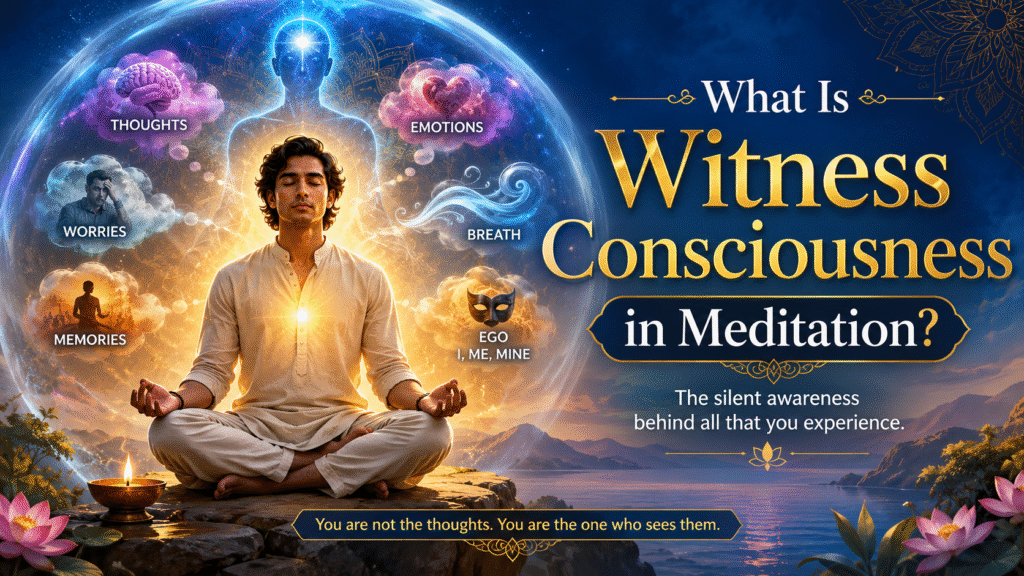
Witness consciousness means the ability to observe the body, mind, emotions, thoughts, memories, desires, fears, and experiences without getting completely identified with them. It is the inner awareness that simply knows what is happening. It does not fight. It does not suppress. It does not become lost. It watches with clarity.
In Indian spiritual tradition, witness consciousness is known by many names: Sakshi Bhava, Drashta, witnessing awareness, pure awareness, or the observing self. In Vedanta, it is connected with the understanding of Atman, the witnessing Self. In Yoga, it is connected with Purusha, the seer. In meditation, it becomes a practical experience through continuous awareness.
Witness consciousness is not imagination. It is not philosophy only. It is a direct meditative state in which we begin to see that thoughts are happening, emotions are happening, sensations are happening, but there is also a silent awareness behind them.
This awareness is peaceful, spacious, and free.
Understanding Witness Consciousness
To understand witness consciousness, we can begin with a simple example. Suppose anger arises in the mind. Usually, we say, “I am angry.” Immediately, we become identified with anger. The anger controls our words, facial expression, decisions, and behavior.
But in meditation, a deeper observation becomes possible. Instead of saying, “I am angry,” we begin to see, “Anger is arising in the mind.” This small shift is very powerful. The anger is still there, but we are no longer fully trapped inside it.
Similarly, when fear comes, we observe, “Fear is present.” When sadness comes, we observe, “Sadness is present.” When thoughts come, we observe, “Thinking is happening.” When the body feels pain, we observe, “Sensation is present.”
This observing awareness is witness consciousness.
It does not mean we become emotionless. It does not mean we reject life. It means we become conscious of what is happening within us. Instead of being dragged by every thought and emotion, we begin to stand in awareness.
This is the beginning of inner freedom.
Witness Consciousness in Yoga Philosophy
In Yoga philosophy, especially in Patanjali’s Yoga Sutras, there is a very important distinction between Purusha and Prakriti. Purusha is the pure seer, the witnessing consciousness. Prakriti is nature, which includes body, senses, mind, emotions, and all changing experiences.
The problem of human suffering arises when Purusha identifies with Prakriti. In simple words, pure awareness forgets itself and becomes identified with body and mind. We begin to think, “I am my body,” “I am my thoughts,” “I am my emotions,” “I am my success,” “I am my pain,” “I am my story.”
Yoga helps us reverse this confusion. Through practice, we slowly recognize that the mind is observed, the body is observed, emotions are observed, but the observer is different from the observed.
This is why Patanjali defines Yoga as “Yoga chitta vritti nirodha,” meaning Yoga is the stilling of the fluctuations of the mind. When the movements of the mind become quiet, the seer rests in its own nature.
Witness consciousness is the beginning of that resting in the seer.
Witness Consciousness in Vedanta
In Vedanta, witness consciousness is called Sakshi. The Sakshi is the witnessing awareness that observes the waking state, dream state, and deep sleep state. It is not the body, not the senses, not the mind, not the intellect, and not the ego. It is the silent knower of all.
Vedanta teaches that we usually mistake ourselves for the changing layers of personality. We say, “I am young,” “I am old,” “I am happy,” “I am sad,” “I am successful,” “I am a failure.” But all these are changing conditions. The body changes, mind changes, emotions change, roles change, relationships change, and social identity changes.
But the basic sense of awareness remains.
When we were children, we had one type of body and mind. In youth, another body and mind. Later in life, another. But the inner sense of “I am aware” continues.
Witness consciousness points us toward this unchanging awareness.
Vedanta uses the method of discrimination: “I am not this, I am not this.” I am not the body because I can observe the body. I am not the mind because I can observe the mind. I am not the ego because I can observe the ego. What remains is pure awareness.
Witness Consciousness in Meditation
In meditation, witness consciousness develops naturally when we observe without reaction. We sit quietly and watch the breath. Thoughts arise. Instead of following them, we notice them and return to awareness. Emotions arise. Instead of suppressing them, we observe them. Body sensations arise. We allow them to be known.
Slowly, we discover that everything is changing. Breath changes. Thoughts change. Mood changes. Body sensations change. Memories change. The sense of identity also changes. But awareness remains present.
This is not an intellectual belief. It becomes an experience.
At first, witnessing may last only for a few seconds. Then we again become lost in thoughts. That is normal. With practice, the gap increases. We are able to observe thoughts for longer without being carried away. We are able to feel emotions without immediately reacting. We are able to sit with discomfort without panic.
This is how meditation strengthens witness consciousness.
Difference Between Witnessing and Thinking
Many beginners confuse witnessing with thinking about themselves. They sit in meditation and start analyzing: “Why am I thinking this? What does this emotion mean? Why did this memory arise?” This is not witnessing. This is mental analysis.
Witnessing is simpler and quieter. It does not analyze too much. It simply observes.
Thinking says: “This thought is good. This thought is bad. I should not think like this. Why am I like this?”
Witnessing says: “A thought is arising.”
Thinking says: “I must control this emotion.”
Witnessing says: “Emotion is present.”
Thinking creates more stories. Witnessing creates space.
Analysis has its place in psychology and self-study, but meditation is not continuous analysis. Meditation is clear awareness. When awareness becomes steady, understanding arises naturally.
Witness Consciousness and Emotional Balance
One of the biggest benefits of witness consciousness is emotional balance. Most of our suffering comes from complete identification with emotions. When anger arises, we become anger. When fear arises, we become fear. When sadness arises, we become sadness.
Witness consciousness creates a small distance between awareness and emotion. This distance is not coldness. It is clarity.
For example, if anxiety arises, we may observe the tightness in the chest, shallow breathing, fast thoughts, and restlessness in the body. Instead of saying, “I am anxious and helpless,” we observe, “Anxiety is moving through the body-mind.”
This shift reduces the grip of emotion. The emotion may still be present, but it is no longer the master. Awareness becomes stronger.
Over time, this helps in daily life also. We react less. We respond more. We speak with more care. We pause before acting. Relationships improve because we are less controlled by emotional storms.
Witness Consciousness and Ego
Ego is the sense of “I,” “me,” and “mine.” It creates identity, ownership, comparison, pride, insecurity, and defensiveness. In daily life, ego is useful at a functional level. We need a name, role, responsibility, and boundary. But when ego becomes the center of life, suffering increases.
Witness consciousness helps us observe the ego.
We begin to notice: “The ego wants appreciation.” “The ego feels hurt.” “The ego is comparing.” “The ego is afraid of being ignored.” “The ego wants to be right.”
This observation is very powerful. When ego is unconscious, it controls us. When ego is observed, its power becomes weaker.
Witness consciousness does not destroy the functional ego violently. It purifies it. It makes the person humble, aware, and less reactive. The person can still work, teach, serve, love, and live in society, but inwardly there is less egoic tension.
The mature spiritual person does not become irresponsible. Rather, he becomes more conscious and compassionate.
Witness Consciousness and Thoughts
Thoughts are natural movements of the mind. The problem is not that thoughts arise. The problem is that we believe every thought and become lost in them.
A thought says, “I am not good enough.” We believe it and suffer.
A thought says, “That person insulted me.” We believe it and become angry.
A thought says, “Something bad will happen.” We believe it and become anxious.
Witness consciousness helps us see thoughts as thoughts. They are mental events, not always truth.
In meditation, when thoughts arise, we do not need to fight them. We also do not need to follow them. We simply notice them. Like clouds moving across the sky, thoughts come and go in awareness.
This understanding brings great relief. We are not forced to obey every thought. We can choose wisely.
Witness Consciousness and the Body
The body is also an object of awareness. We can observe the posture, breath, heartbeat, warmth, coolness, pain, pressure, relaxation, and movement. This means we are aware of the body.
In meditation, body awareness is a very important doorway. By observing body sensations, we become grounded. We also learn impermanence. A sensation arises, changes, and passes.
Witnessing the body helps reduce fear of sensations. Many people become anxious when they feel pain, tightness, or discomfort. But when they observe carefully, they see that sensations are changing. This creates patience and calmness.
The body becomes not an enemy, but a field of awareness.
Witness Consciousness and Breath
Breath is one of the easiest objects for developing witness consciousness. It is always present. It is natural. It connects body and mind.
When we observe the breath, we are practicing witnessing. Inhalation comes, and we know it. Exhalation goes, and we know it. The breath may be deep or shallow, long or short, smooth or rough. We simply observe.
Slowly, the breath becomes a mirror. If the mind is restless, breath shows restlessness. If the body is tense, breath shows tension. If awareness deepens, breath becomes subtle.
By witnessing the breath, we learn to witness the mind.
This is why breath awareness is used in Yoga, Buddhism, mindfulness, and many meditation traditions.
Witness Consciousness and Daily Life
Witness consciousness should not remain limited to the meditation cushion. The real test is daily life.
When someone criticizes us, can we observe the reaction before replying?
When desire arises, can we observe it before acting blindly?
When fear comes, can we breathe and watch?
When success comes, can we notice pride without being swallowed by it?
When failure comes, can we notice disappointment without losing self-worth?
This is living meditation.
Witness consciousness helps us live with more awareness. It gives us inner pause. That pause is sacred. In that pause, we are free to choose a better response.
Without witnessing, life is mechanical. With witnessing, life becomes conscious.
Common Misunderstandings About Witness Consciousness
Some people think witness consciousness means becoming detached in a cold or insensitive way. This is not true. Real witnessing does not make us hard. It makes us more compassionate because we are no longer trapped in ego reactions.
Some think witnessing means suppressing emotions. This is also wrong. Suppression pushes emotions down. Witnessing allows emotions to be seen clearly.
Some think witnessing means doing nothing. But witnessing is not passivity. It is clear seeing. After seeing clearly, right action can arise.
Some think witness consciousness is only for advanced yogis. Actually, everyone can begin practicing it. Even a small moment of awareness before reacting is witness consciousness.
A Simple Practice to Develop Witness Consciousness
Sit comfortably with the spine straight. Close the eyes gently. Take a few natural breaths.
First, observe the body. Feel the posture, contact with the ground, and sensations.
Now observe the breath. Let it move naturally. Know inhalation. Know exhalation.
Now observe thoughts. Do not stop them. Just watch. If a thought comes, silently note, “Thinking.”
Now observe emotions. If calmness is present, know calmness. If restlessness is present, know restlessness.
Now observe the sense of “I am meditating.” Even this sense can be observed.
Finally ask silently: “Who is aware of all this?”
Do not answer mentally. Remain in silence.
This silence points toward witness consciousness.
Practice for 10 to 15 minutes daily.
Witness Consciousness and Spiritual Growth
Witness consciousness is a major step in spiritual growth. It shifts us from identification to awareness. Earlier we lived as body-mind-ego. Now we begin to live as awareness observing body-mind-ego.
This does not mean the body and mind disappear. They continue. Life continues. Duties continue. But our relationship with them changes.
We become less reactive, less fearful, less egoistic, and less attached to mental stories. We begin to feel inner spaciousness.
In deeper meditation, witness consciousness can lead toward profound states of silence. The observer becomes steady. The mind becomes quiet. The distinction between observer and observed may also dissolve in higher states of meditation.
But even before such advanced states, witness consciousness greatly improves life.
Learn Meditation with Adwait Yoga School
Those who want to learn meditation deeply and systematically can explore the Meditation Teacher Training Course offered by Adwait Yoga School.
Adwait Yoga School offers a Meditation Teacher Training Course for students, yoga practitioners, spiritual seekers, healers, and those who want to become meditation teachers. The course supports deeper understanding of meditation techniques, breath awareness, mindfulness, concentration, mantra meditation, yogic psychology, meditation teaching methodology, and inner discipline.
You can visit the Meditation Teacher Training Course page here:
https://adwaityoga.com/meditation-teacher-training-course
Learning meditation through a structured course is very helpful because meditation is not only sitting silently. It involves understanding the body, breath, mind, emotions, ego, awareness, and inner transformation. With proper guidance, meditation becomes safe, deep, and practical.
Final Understanding
Witness consciousness in meditation is the ability to observe all experiences without becoming completely identified with them. It is the silent awareness that watches the body, breath, thoughts, emotions, ego, memories, and sensations.
The body is observed. The breath is observed. Thoughts are observed. Emotions are observed. Ego is observed. Therefore, the witness is deeper than all these.
This witnessing awareness is not cold or lifeless. It is peaceful, alert, compassionate, and free.
In daily life, witness consciousness helps us pause before reacting, understand emotions, reduce overthinking, soften ego, and live with more clarity. In meditation, it opens the door to deeper silence and spiritual realization.
The journey begins with a simple practice: sit, breathe, observe.
Whenever thoughts arise, witness them.
Whenever emotions arise, witness them.
Whenever ego reacts, witness it.
Again and again, return to awareness.
Slowly, you will discover that you are not merely the changing waves of the mind. You are the awareness in which the waves arise and pass.
This discovery is one of the greatest blessings of meditation.
It is the beginning of true inner freedom.