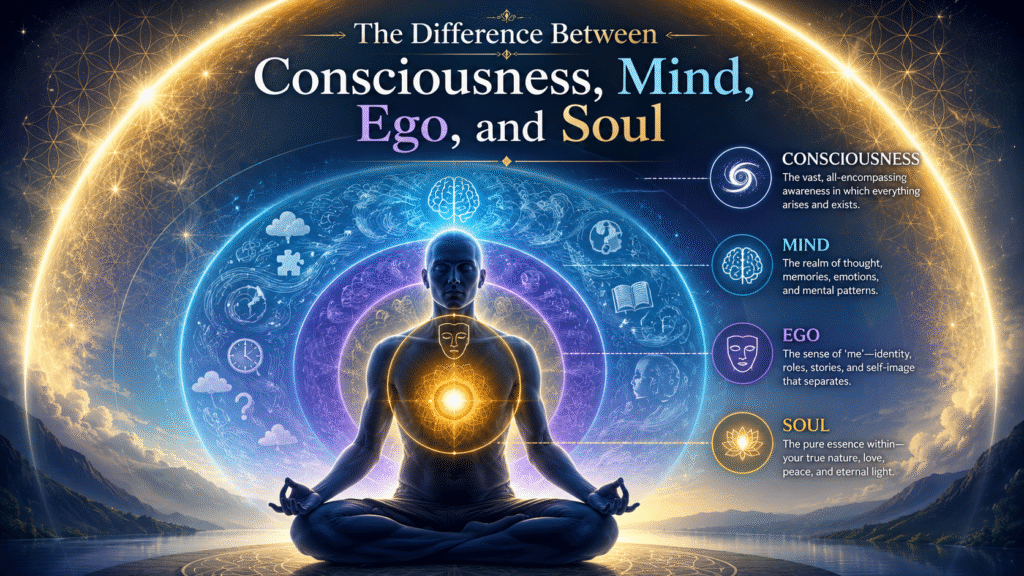
In spiritual study, meditation, yoga, Vedanta, Buddhism, and modern psychology, we often hear words like consciousness, mind, ego, and soul. These words are very common, but their meanings are not always clearly understood. Many people use them interchangeably, but in deeper spiritual understanding, each one points to a different dimension of our inner life.
A seeker may ask: Am I the mind? Am I the ego? Is consciousness the same as soul? What is the difference between thoughts and awareness? Who is watching the thoughts? What continues beyond body and mind? These questions are not only philosophical. They are deeply practical because the way we understand ourselves affects the way we live, meditate, suffer, react, and grow.
In Indian spiritual tradition, self-inquiry has always been considered very important. The Upanishads ask, “Who am I?” Yoga speaks of Purusha and Prakriti. Vedanta speaks of Atman and Brahman. Buddhism analyzes mind, consciousness, ego-illusion, and non-self. Modern psychology speaks of identity, personality, cognition, self-image, and awareness. Though the languages are different, the central inquiry remains the same: What is our real nature?
To understand this properly, we need to look at four important inner aspects: consciousness, mind, ego, and soul.
What is Consciousness?
Consciousness is the basic light of knowing. It is that by which we know anything. We know thoughts because consciousness is present. We know emotions because consciousness is present. We know body sensations because consciousness is present. We know pleasure, pain, memory, imagination, and dreams because consciousness is present.
Consciousness is not a thought. It is that which knows the thought.
For example, when anger arises, you know that anger is present. When sadness comes, you know sadness is present. When a thought comes, you know the thought. This knowing power is consciousness.
In simple words, consciousness is awareness itself.
In Vedantic language, consciousness is often understood as Chaitanya or pure awareness. It is the witnessing principle. It is not limited to one thought, one emotion, or one identity. It is the background in which all experiences appear.
When you are awake, experiences arise in consciousness. When you dream, dream experiences arise in consciousness. Even in deep sleep, where there is no ordinary mental activity, there is a subtle continuity because after waking we say, “I slept well.” This indicates that some deeper witnessing principle remains beyond ordinary thought.
Consciousness is like light. If there is light in a room, objects can be seen. The light does not become the table, chair, wall, or window. It simply illuminates them. Similarly, consciousness illumines thoughts, emotions, sensations, and perceptions, but it is not limited by them.
What is Mind?
Mind is the inner instrument that thinks, feels, remembers, imagines, compares, judges, plans, and reacts. In Sanskrit, the broad inner instrument is called Antahkarana. It includes different functions such as manas, buddhi, ahamkara, and chitta.
Manas is the thinking and sensory-processing mind. It receives impressions and creates options.
Buddhi is intelligence, discrimination, and decision-making faculty.
Chitta is memory, impressions, and the storehouse of mental patterns.
Ahamkara is the ego-sense, the “I-maker.”
In daily language, when we say “mind,” we usually mean thoughts, emotions, memories, imagination, attention, and mental habits. The mind is active, changing, and movement-oriented.
One moment the mind is happy. Next moment it is worried. One moment it loves. Next moment it dislikes. It moves from past to future, from desire to fear, from comparison to judgment. This is why Yoga says the mind is full of vrittis, or modifications.
Patanjali defines Yoga as the cessation or stilling of the fluctuations of the mind: Yoga chitta vritti nirodha. This does not mean destroying the mind. It means calming its restless movements so that the deeper reality can be seen clearly.
The mind is a tool. It is useful for learning, communication, planning, creativity, and worldly life. But when we identify completely with the mind, suffering begins. We start believing every thought. We become controlled by emotions. We think our memories are our identity. We become trapped in overthinking.
Meditation helps us see that the mind is not the final self. It is an instrument that can be observed.
What is Ego?
Ego is the sense of “I” as a separate individual identity. It is the inner feeling: “I am this body,” “I am this name,” “I am this role,” “I am successful,” “I am a failure,” “I am superior,” “I am inferior,” “This is mine,” “I am the doer.”
In Sanskrit, ego is called Ahamkara. Aham means “I,” and kara means “maker.” So Ahamkara means the “I-maker.” It creates the sense of individuality and ownership.
Ego is not always bad in the ordinary sense. For practical life, we need a functional identity. We need to know our name, responsibilities, relationships, duties, profession, and boundaries. Without any ego-function, worldly life would become difficult.
The problem is not functional ego. The problem is false identification.
When ego becomes too strong, it creates pride, insecurity, jealousy, comparison, control, fear, attachment, and defensiveness. It wants recognition. It wants to be special. It wants to be right. It wants to possess. It gets hurt easily.
In spiritual practice, ego is not destroyed violently. It is understood, purified, softened, and transcended. A mature seeker does not become ego-less in an unhealthy way. Rather, he becomes less ego-centered. He can function in the world, but inwardly he knows: “I am not merely this limited personality.”
In meditation, we observe the ego. We notice how it reacts, how it wants praise, how it fears criticism, how it creates stories. When ego is seen clearly, its grip reduces.
What is Soul?
The word soul can mean different things depending on tradition. In Indian Vedantic understanding, soul is often close to the idea of Atman, the inner Self. Atman is not the ego. It is not the changing mind. It is the deeper spiritual essence, the pure Self, the witnessing consciousness.
In common spiritual language, the soul is understood as the inner spiritual being, the essence that is deeper than body and mind. It is the dimension of our existence that feels connected with truth, love, purity, and higher purpose.
However, in Buddhism, the idea of a permanent independent soul is not accepted in the same way. Buddhism teaches anatta, or non-self. According to this view, what we call “self” is actually a combination of body, feelings, perceptions, mental formations, and consciousness, all changing moment by moment. Buddhism does not deny experience, awareness, or continuity, but it questions the idea of a fixed, separate, permanent soul.
This is why the word soul should be used carefully. In Vedanta, the true Self is eternal consciousness. In devotional traditions, the soul is the individual spiritual essence seeking union with the Divine. In Buddhism, clinging to a permanent self is seen as a cause of suffering.
For a practical seeker, we may understand soul as the deepest spiritual dimension of our being, beyond ego and mental noise. It is not the social identity. It is not emotional drama. It is the call toward truth, compassion, freedom, and awakening.
Consciousness vs Mind
Consciousness and mind are closely related in experience, but they are not the same.
Mind is the movement. Consciousness is the knowing of the movement.
Mind thinks. Consciousness knows that thinking is happening.
Mind feels. Consciousness knows that feeling is happening.
Mind remembers. Consciousness knows that memory is arising.
Mind changes constantly. Consciousness remains as the witnessing presence.
A simple example can make this clear. Suppose a thought comes: “I am worried.” The thought is part of the mind. But the fact that you know this thought means consciousness is present. If another thought comes, “I am peaceful,” the mind has changed. But the knowing remains.
The mind is like clouds. Consciousness is like the sky. Clouds come and go. The sky remains. Sometimes clouds are dark, sometimes white, sometimes scattered. But the sky is not damaged by them. Similarly, thoughts and emotions arise and pass, but consciousness remains the space in which they appear.
Meditation helps us shift from being lost in the mind to resting in consciousness.
Mind vs Ego
Mind is the broader inner instrument. Ego is one function within the mind.
The mind includes thoughts, emotions, memories, imagination, attention, and reasoning. Ego is the part that says, “This is me,” “This is mine,” “I am doing,” “I am the sufferer,” “I am the achiever.”
For example, a thought arises: “This person insulted me.” The thought belongs to the mind. But the hurt identity that says, “How dare they insult me?” is ego.
Another thought arises: “I did this work very well.” This is mental cognition. But the pride that says, “I am better than others” is ego.
So mind is the field of mental activity, while ego is the personal center around which this activity is organized.
In spiritual practice, we do not need to hate the ego. We need to see it clearly. Ego becomes problematic when it claims everything and forgets the deeper Self.
Ego vs Soul
Ego and soul are often confused, but they are very different.
Ego says, “I am this name, this body, this status, this achievement, this pain, this story.”
Soul says, “I am deeper than all these changing identities.”
Ego wants validation. Soul seeks truth.
Ego compares. Soul connects.
Ego fears losing control. Soul trusts the deeper flow of life.
Ego reacts. Soul responds.
Ego is restless because it depends on external conditions. Soul is peaceful because it is rooted in inner being.
When a person lives only from ego, life becomes a constant struggle for recognition, control, success, and security. When a person begins to live from soul, life becomes more meaningful, compassionate, honest, and spiritually aligned.
However, we should not use the idea of soul to escape real responsibilities. True spirituality does not make us careless. It makes us more conscious, humble, and loving.
Consciousness vs Soul
This is a subtle point. In Vedantic understanding, pure consciousness and true Self are ultimately one. Atman is pure consciousness. The soul, in its highest sense, is not separate from consciousness.
But in common language, soul is sometimes used to mean the individual spiritual essence, while consciousness refers to the universal field of awareness. In this sense, soul may be seen as the individual expression of consciousness.
For example, one may say consciousness is like the ocean, and soul is like a wave. The wave appears individual, but its essence is water. Similarly, the soul appears individual, but its deepest reality is consciousness.
In the highest realization, the separation between individual soul and universal consciousness dissolves. This is the essence of many non-dual teachings.
The Role of Meditation
Meditation is the practical path to understand the difference between consciousness, mind, ego, and soul. Without meditation, these remain only concepts. With meditation, they become direct experience.
When you sit in meditation, you first notice the body. Then you notice the breath. Then you notice thoughts. Then emotions. Then memories. Then the sense of “I” who is thinking. Gradually, you begin to see that all these are objects of awareness.
If thoughts can be observed, you are not merely thoughts.
If emotions can be observed, you are not merely emotions.
If ego can be observed, you are not merely ego.
What remains as the observer? This question opens the door to consciousness.
Meditation does not require belief. It requires observation. Slowly, the seeker discovers that there is a witnessing presence deeper than the mind. This witnessing presence is peaceful, spacious, and free.
A Simple Practice to Experience the Difference
Sit comfortably with the spine straight. Close the eyes gently. Take a few natural breaths.
First observe the body. Notice sensations in the legs, back, shoulders, and face. Say inwardly: “The body is being observed.”
Now observe the breath. Feel inhalation and exhalation. Say inwardly: “The breath is being observed.”
Now observe thoughts. Do not stop them. Let them come and go. Say inwardly: “Thoughts are being observed.”
Now observe emotions. Maybe there is calmness, restlessness, joy, irritation, or nothing special. Say inwardly: “Emotions are being observed.”
Now observe the sense of “I.” Notice any feeling of “I am meditating,” “I am doing,” or “I want peace.” Say inwardly: “The ego-sense is being observed.”
Now ask silently: “Who is observing?”
Do not answer intellectually. Just remain silent.
This silence points toward consciousness.
Modern Psychology and These Four Aspects
Modern psychology may not always use the same language as Yoga or Vedanta, but it also recognizes different layers of human experience. It speaks of cognition, emotion, self-image, identity, awareness, subconscious patterns, and personality.
The mind can be compared with mental processes such as thinking, memory, emotion, and perception. Ego can be compared with identity structure or self-concept. Consciousness can be related to awareness or the capacity for subjective experience. Soul is more spiritual and may not be directly used in scientific psychology, but it connects with meaning, values, depth, and existential identity.
A holistic approach does not need to reject modern psychology or spirituality. Both can help us understand the human being. Psychology helps us heal patterns. Meditation helps us go beyond patterns. Yoga helps integrate body, breath, mind, and consciousness.
Why This Understanding Matters in Daily Life
Understanding these differences is not only for philosophy. It changes daily life.
When you know you are not every thought, you stop believing every negative idea.
When you know you are not every emotion, you stop becoming overwhelmed by anger or fear.
When you know ego is only a function, you become less defensive and more humble.
When you feel connected with soul, your life becomes more meaningful.
When you rest in consciousness, you experience inner freedom.
This understanding improves relationships also. Many conflicts happen because ego reacts. If we pause and observe, we can respond from awareness. Instead of saying, “I am hurt, so I must attack,” we can say, “Hurt is arising; let me understand it.”
This is spiritual maturity.
Learn Meditation with Adwait Yoga School
Those who want to understand the mind, awareness, meditation, and inner transformation in a systematic way can explore the Meditation Teacher Training Course offered by Adwait Yoga School.
Adwait Yoga School offers Meditation Teacher Training Courses for seekers, yoga practitioners, healers, teachers, and those who want to deepen their own meditation practice. A structured meditation training helps students understand different meditation techniques, breath awareness, mindfulness, concentration, mantra meditation, yogic psychology, teaching methodology, and the inner discipline required for meditation.
You can visit the Meditation Teacher Training Course page here:
https://adwaityoga.com/meditation-teacher-training-course
Learning meditation under proper guidance is very helpful because meditation is not only sitting silently. It is a complete process of understanding the body, breath, mind, ego, emotions, awareness, and deeper Self. With correct training, meditation becomes safe, deep, and transformative.
Final Understanding
Consciousness, mind, ego, and soul are four important words in spiritual life, but they should not be mixed casually.
Consciousness is the pure knowing, the awareness in which all experiences appear.
Mind is the inner instrument of thoughts, emotions, memories, imagination, and perception.
Ego is the “I-maker,” the sense of separate identity and ownership.
Soul is the deeper spiritual essence or true Self, understood differently in different traditions but always pointing beyond ordinary personality.
The mind changes. Ego claims. Soul seeks truth. Consciousness witnesses.
When we are identified with mind, life becomes restless. When we are identified with ego, life becomes full of comparison and fear. When we connect with soul, life becomes meaningful. When we awaken as consciousness, life becomes free.
The journey of yoga and meditation is the journey from unconscious identification to conscious witnessing. It is the movement from “I am my thoughts” to “Thoughts are arising in awareness.” It is the movement from ego-centered living to soul-centered living. It is the movement from mental noise to inner silence.
In the end, this understanding is not meant only for reading. It is meant for practice. Sit quietly. Observe the body. Observe the breath. Observe the mind. Observe the ego. Remain aware.
Slowly, the truth begins to reveal itself.
You are not merely the body. You are not merely the mind. You are not merely the ego-story. You are the witnessing awareness in which all experiences arise and pass.
To know this directly is the beginning of real inner freedom.