In today’s fast and busy lifestyle, lack of focus has become a common problem. Students sit for study, but the mind keeps going toward the phone, social media, future worries, or random thoughts. Working professionals open the laptop with good intention, but after some time the mind becomes tired, scattered, and unclear. Many people try to meditate, but the mind does not remain steady even for a few minutes.
This is not only a personal weakness. Modern life itself is designed in such a way that the mind becomes overloaded. Continuous notifications, stress, emotional pressure, irregular sleep, poor food habits, overthinking, and too much screen time disturb the nervous system. When the nervous system is disturbed, the breath becomes shallow. When the breath becomes shallow, the mind becomes restless. And when the mind becomes restless, focus and clarity become weak.
In such a situation, Pranayama is one of the most powerful and natural practices for improving focus and mental clarity. Pranayama does not require expensive equipment or complicated arrangements. It only requires proper guidance, correct technique, regularity, and patience.
In Indian yogic tradition, Pranayama is not merely a breathing exercise. It is the regulation and expansion of prana, the life-force energy. Breath is the visible expression of prana. When breath is disturbed, prana becomes disturbed. When prana is disturbed, the mind becomes disturbed. When breath becomes steady and refined, prana becomes balanced, and the mind naturally becomes calm, focused, and clear.
This is why ancient yogis gave so much importance to Pranayama. They understood that breath is the bridge between body, mind, nervous system, emotions, and consciousness.
What is Pranayama?
The word Pranayama comes from two Sanskrit words: Prana and Ayama. Prana means life-force energy, and Ayama means expansion, regulation, or extension. So Pranayama means the conscious regulation and expansion of life-force energy through breath.
Many people think Pranayama means only inhaling and exhaling in different styles. But traditional Yoga goes much deeper. Breath is the doorway; prana is the real subject. Through breath, the practitioner learns to influence the subtle energy system, nervous system, emotions, and mind.
In daily life, breathing happens automatically. We usually do not notice it. But the breath is always reflecting our inner condition. When we are angry, the breath becomes hot and fast. When we are anxious, breath becomes shallow. When we are sad, breath becomes heavy. When we are peaceful, breath becomes smooth and rhythmic.
This shows that breath and mind are deeply connected. Pranayama uses this connection consciously.
Why Focus and Mental Clarity Decline
Before understanding how Pranayama improves focus, we should first understand why focus becomes weak.
The mind loses focus when it is overloaded. Too many thoughts, too many emotions, too much digital information, lack of sleep, unhealthy food, stress, anxiety, and scattered lifestyle weaken attention. The mind becomes like a room full of noise. Even if intelligence is present, it cannot function properly because there is no inner silence.
Another important reason is shallow breathing. Many people breathe only from the upper chest. When breathing is shallow, the body remains in a mild stress state. The brain receives signals that something is wrong or unsafe. This creates restlessness, impatience, irritation, and poor concentration.
Mental clarity also declines when the mind is covered by worry, fear, anger, comparison, confusion, or emotional disturbance. A disturbed mind cannot see things clearly. It keeps jumping from one thought to another.
In yogic language, these are movements of chitta, the mind-stuff. When chitta is disturbed, buddhi, the faculty of discrimination and clear understanding, becomes weak. When the mind becomes calm, buddhi becomes bright and clear.
Pranayama helps by calming the breath, balancing prana, and reducing inner restlessness.
Breath is the Bridge Between Body and Mind
The breath is very special because it belongs to both body and mind. It happens automatically, but we can also regulate it consciously. This makes breath a direct doorway into the nervous system and mind.
When you are stressed, someone may say, “Take a deep breath.” This simple advice works because deep breathing sends a signal of safety to the body. The heart rate may settle, muscles may relax, and the mind may become less reactive.
In Yoga, this simple principle is developed into a complete science. Pranayama trains the practitioner to breathe consciously, rhythmically, and with awareness. Over time, this changes the quality of attention.
A scattered breath creates scattered awareness. A steady breath creates steady awareness.
When the breath becomes smooth, the mind follows. When the breath becomes subtle, thoughts become fewer. When thoughts become fewer, focus becomes stronger.
Pranayama and the Nervous System
Modern science also helps us understand why Pranayama is so effective. Breath is closely connected with the autonomic nervous system, which regulates functions like heart rate, digestion, stress response, relaxation, and recovery.
Fast and shallow breathing can increase stress response. Slow and steady breathing can support parasympathetic activation, which is connected with rest, recovery, calmness, and emotional balance.
This matters deeply for focus. A stressed nervous system cannot concentrate properly. When the body is in fight-or-flight mode, attention becomes restless and defensive. The brain is busy scanning for problems. But when the nervous system is calm, attention becomes stable and clear.
Pranayama helps shift the system from stress mode to balance mode. This is why even 5 to 10 minutes of correct breathing can make the mind feel lighter, quieter, and clearer.
Pranayama Reduces Overthinking
Overthinking is one of the biggest enemies of focus. The mind keeps repeating the same thoughts again and again. One small issue becomes a big mental story. A simple decision becomes complicated. A small mistake becomes a long chain of worry.
Overthinking consumes mental energy. A person may sit for hours but achieve very little because the mind is busy in unnecessary thought loops.
Pranayama helps reduce overthinking by giving the mind a steady object. When you observe the breath, count the breath, or regulate inhalation and exhalation, the mind gets something simple and rhythmic to hold.
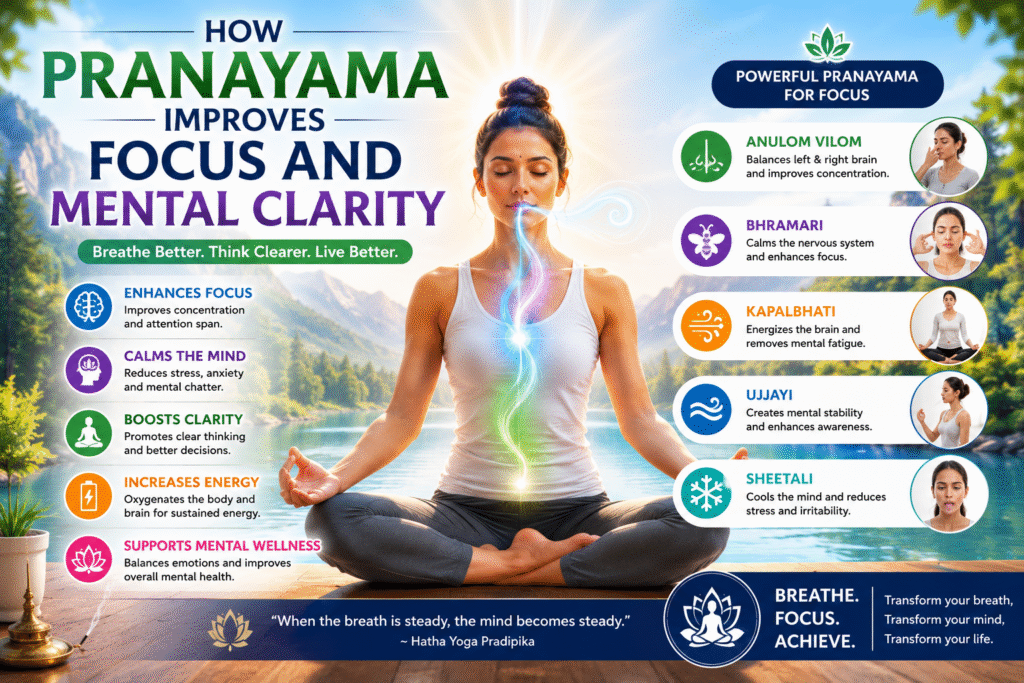
For example, in Nadi Shodhana, attention remains on the nostrils, fingers, inhalation, exhalation, and rhythm. This naturally reduces unnecessary thinking. Slowly, mental waves become quieter.
In yogic understanding, breath and thought are connected. When breath becomes rhythmic, thought also becomes rhythmic. When breath becomes subtle, thought becomes subtle. This is why Pranayama is one of the best preparations for meditation.
Pranayama Improves Attention
Attention is like a muscle. If we train it, it becomes stronger. Pranayama trains attention in a gentle but powerful way.
During Pranayama, you must remain aware of the breath. You observe how you inhale, how you exhale, how long the breath is, whether it is smooth or disturbed, whether the body is relaxed or tense. This repeated observation strengthens present-moment awareness.
In practices like Nadi Shodhana, Ujjayi, Bhramari, and Deep Yogic Breathing, attention remains anchored. The mind may wander, but again and again it returns to the breath. This repeated returning improves focus.
This is very similar to meditation. In meditation, when the mind wanders, we bring it back to the object. In Pranayama, when the mind wanders, we bring it back to breath rhythm. Over time, this develops mental discipline.
Nadi Shodhana for Mental Balance
Nadi Shodhana, or alternate nostril breathing, is one of the best Pranayama practices for focus and clarity. In traditional Yoga, it is used to purify the nadis, balance Ida and Pingala, and prepare the mind for meditation.
Ida is associated with cooling, lunar, calming energy. Pingala is associated with heating, solar, active energy. When these two are balanced, the mind becomes steady. When they are disturbed, the mind may become either dull or restless.
Nadi Shodhana balances both sides. It calms emotional disturbance, reduces mental agitation, and improves clarity.
For students, teachers, professionals, meditators, and spiritual seekers, Nadi Shodhana is highly useful. It can be practiced before study, before meditation, before teaching, before important work, or before sleep.
A simple practice is to sit comfortably, close the right nostril, inhale through the left, close the left, exhale through the right, inhale through the right, close the right, and exhale through the left. This completes one round. Practice gently without strain.
Bhramari Pranayama for Calm Focus
Bhramari Pranayama, also called humming bee breath, is very effective for calming the mind. In this practice, the practitioner inhales gently and exhales with a soft humming sound.
The vibration of humming relaxes the head, face, throat, and nervous system. It can reduce mental noise and emotional tension. Many people feel peaceful after only a few rounds.
Bhramari is especially helpful when the mind is irritated, anxious, overstimulated, or tired. It brings attention inward and creates a soothing vibration. This supports mental clarity.
For people who struggle with too many thoughts before meditation, Bhramari can be a beautiful preparation. It softens mental activity and brings the mind into a meditative mood.
Deep Yogic Breathing for Clarity
Deep Yogic Breathing is the foundation of breath awareness. It includes abdominal breathing, rib expansion, and chest expansion in a natural and relaxed way.
Many people breathe only from the upper chest. This keeps the nervous system slightly tense. Deep Yogic Breathing teaches the body to breathe fully and calmly.
When the abdomen moves gently with the breath, the body feels safer. When the ribs expand, breathing becomes more spacious. When the chest opens, energy improves. Together, this supports both relaxation and alertness.
Mental clarity needs both calmness and alertness. If we are too relaxed, we may become sleepy. If we are too stimulated, we become restless. Deep Yogic Breathing helps create balanced awareness.
Ujjayi Pranayama and Inner Focus
Ujjayi Pranayama is a gentle breath practice where the throat is slightly narrowed, creating a soft ocean-like sound. It is often used in yoga and meditation practices to build inner focus.
The sound of Ujjayi gives the mind a subtle anchor. It also makes the breath smooth and controlled. This helps the practitioner remain present.
When practiced correctly, Ujjayi can create warmth, steadiness, and inward attention. It is useful for those who feel scattered or mentally weak. However, it should be practiced softly. There should be no force or pressure in the throat.
Ujjayi is not about making loud sound. It is about refining breath and awareness.
Kapalabhati and Mental Sharpness
Kapalabhati is often translated as skull-shining practice. It involves active exhalations and passive inhalations. Traditionally, it is considered a cleansing kriya and is also used as an energizing practice.
When done correctly and moderately, Kapalabhati can increase alertness and mental sharpness. It can remove dullness and bring energy to the mind.
However, Kapalabhati is not suitable for everyone. People with high blood pressure, heart disease, pregnancy, epilepsy, panic disorder, hernia, recent surgery, or serious health problems should avoid it or practice only under expert guidance.
For focus and clarity, Kapalabhati should not be overdone. A few gentle rounds under proper guidance are enough. Too much force can create heat, headache, irritation, or restlessness.
Pranayama and Brain Function
From a modern perspective, Pranayama may support brain function in different ways. Slow breathing can improve oxygen efficiency, calm stress response, and improve attention regulation. Breath awareness also activates brain networks involved in self-awareness and emotional control.
When the mind is calm, the prefrontal areas related to attention and decision-making can function better. When stress reduces, emotional reactivity reduces. When emotional reactivity reduces, thinking becomes clearer.
Pranayama also improves interoception, which means awareness of internal bodily sensations. A person becomes more aware of breath, heartbeat, tension, relaxation, and emotional changes. This improves self-regulation.
In simple words, Pranayama helps the brain work in a more organized and balanced way.
Pranayama Before Study or Work
Students and professionals can use Pranayama practically. Before study, practice 5 minutes of Nadi Shodhana or Deep Yogic Breathing. This can help reduce distractions and prepare the mind for learning.
Before office work or important meetings, slow breathing can reduce stress and improve decision-making. Before writing, teaching, or creative work, Bhramari can help quiet mental noise.
It is also helpful to take short breath breaks during the day. Instead of continuously working until the mind becomes tired, pause for 2 minutes. Sit straight. Inhale gently. Exhale slowly. Observe the breath. Then return to work.
Small practices done regularly create big changes over time.
Pranayama and Meditation
Pranayama is one of the best preparations for meditation. Many people say they cannot meditate because the mind is restless. But often the problem is that they sit directly without preparing the breath and prana.
A few minutes of Pranayama before meditation can make a big difference. Breathwork removes restlessness, balances energy, and brings awareness inward. Then meditation becomes more natural.
In Patanjali’s Yoga system, Pranayama comes before Pratyahara, Dharana, Dhyana, and Samadhi. This shows its importance. Breath regulation helps withdraw the senses, strengthen concentration, and prepare for meditation.
Learn Pranayama with Adwait Yoga School
Those who wish to learn Pranayama deeply and systematically can explore the Pranayama Teacher Training Course offered by Adwait Yoga School.
Adwait Yoga School offers certified Pranayama Teacher Training Courses in India. The course page describes Pranayama Teacher Training as a comprehensive training program about Pranayama and notes that the courses are certified by Yoga Alliance USA and World Yoga Alliance accredited school, Adwait Yoga School. The training includes authentic knowledge, in-depth training, philosophical as well as practical training, mandatory text, lifetime professional guidance, and work opportunities.
You can visit the Pranayama Teacher Training Course page here:
Learning Pranayama through a structured course is important because breathwork is powerful. A qualified teacher helps students understand the mechanics of breathing, prana, different techniques, safety precautions, sequencing, and teaching methodology. Proper guidance helps the student practice with confidence, balance, and discipline.
A Simple Pranayama Routine for Focus
A beginner can follow a simple routine for mental clarity.
Sit comfortably with the spine straight. Take 2 minutes of natural breath observation. Then practice 5 rounds of Deep Yogic Breathing. After that, practice 5 to 7 rounds of Nadi Shodhana. Then practice 3 to 5 rounds of Bhramari. Finally, sit quietly for 2 minutes and observe the mind.
This routine can be practiced in the morning, before study, before meditation, or in the evening after work. It should feel comfortable. There should be no strain, dizziness, or pressure.
Regularity is more important than intensity.
Safety Guidelines
Pranayama is powerful and should be practiced correctly. Always sit with a straight spine. Practice on an empty or light stomach. Do not force inhalation, exhalation, or retention. Do not compete with others.
If you feel dizziness, chest discomfort, headache, panic, or strong discomfort, stop immediately and breathe naturally.
People with high blood pressure, heart disease, epilepsy, pregnancy, severe anxiety, respiratory illness, or serious medical conditions should learn from a qualified teacher and consult a healthcare professional if needed.
Advanced practices like Bhastrika, Kapalabhati, and Kumbhaka should be practiced only under proper guidance.
Conclusion
Pranayama improves focus and mental clarity because it works at the root level of breath, prana, nervous system, and mind. A restless breath creates a restless mind. A steady breath creates a steady mind. When the breath becomes conscious, attention becomes stronger. When prana becomes balanced, thoughts become clearer. When the nervous system becomes calm, mental clarity naturally arises.
Practices like Deep Yogic Breathing, Nadi Shodhana, Bhramari, and gentle Ujjayi can help reduce overthinking, improve attention, calm emotional disturbance, and prepare the mind for meditation. Activating practices like Kapalabhati can support alertness when done correctly, but they must be practiced carefully.
In the yogic tradition, breath is not only air. Breath is the movement of life-force. By refining the breath, we refine the mind. By refining the mind, we refine our actions, decisions, and spiritual path.
For students, professionals, teachers, meditators, and seekers, Pranayama is a practical and sacred tool. It brings the scattered mind back to the present moment. It clears inner fog. It awakens steady awareness.
When the breath becomes calm, the mind becomes clear. When the mind becomes clear, focus becomes natural. And when focus becomes natural, life becomes more conscious, balanced, and spiritually meaningful.