In the ancient Indian yogic tradition, breath has always been considered much more than the movement of air in and out of the lungs. Breath is understood as the visible expression of prana, the life-force energy that sustains the body, mind, senses, emotions, and consciousness. When breath is disturbed, the mind becomes disturbed. When breath becomes calm, the mind also begins to calm down.
Today, modern science is also beginning to understand what the yogis knew through direct experience. One of the important scientific explanations behind the calming effect of Pranayama is its influence on the vagus nerve.
The vagus nerve is one of the most important nerves in the human body. It plays a major role in relaxation, emotional balance, digestion, heart rhythm, breathing, inflammation regulation, and the body’s ability to recover from stress. When the vagus nerve functions well, the body can shift more easily from stress mode to healing mode.
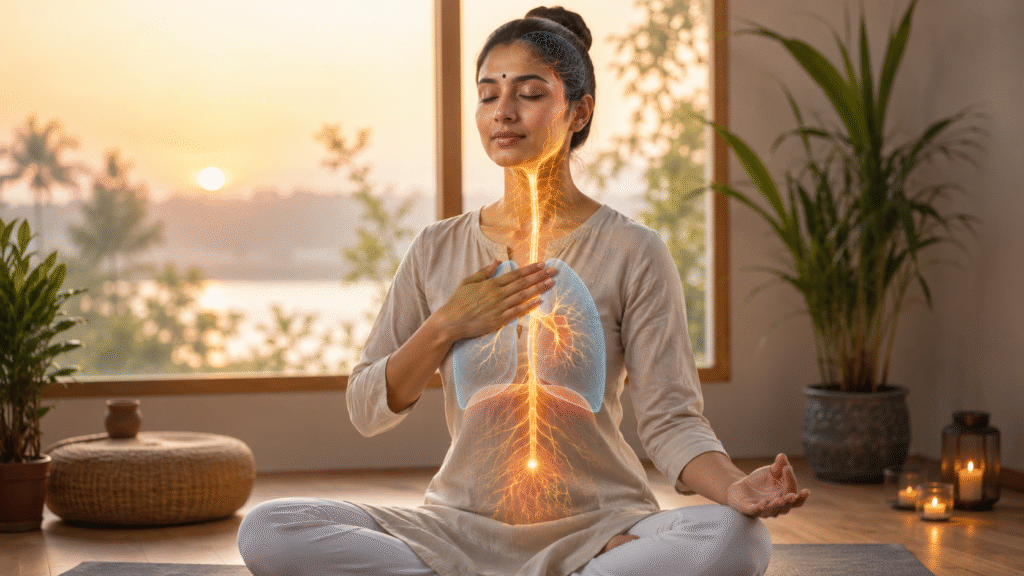
Pranayama naturally supports this process. Slow breathing, deep breathing, extended exhalation, humming, chanting, and mindful breath awareness can gently stimulate the vagus nerve and activate the parasympathetic nervous system. This is why after practicing Pranayama, many people feel calm, grounded, emotionally lighter, and mentally clearer.
In simple words, Pranayama is a natural bridge between yogic wisdom and modern nervous-system science.
What is the Vagus Nerve?
The word vagus comes from Latin and means “wandering.” The vagus nerve is called the wandering nerve because it travels from the brainstem down through the neck, chest, heart, lungs, diaphragm, stomach, and digestive organs. It connects the brain with many important organs of the body.
It is one of the main nerves of the parasympathetic nervous system, which is commonly known as the rest-and-digest system. This system helps the body relax, digest food, repair tissues, regulate heart rate, and recover from stress.
When the vagus nerve is healthy and active, the body can calm down after stress. The heart rate becomes more balanced. Breathing becomes smoother. Digestion improves. Emotions become easier to regulate. The mind becomes clearer.
When vagal tone is low, a person may feel more anxious, reactive, stressed, emotionally unstable, tired, or disconnected from the body. Stress may take longer to settle. Sleep may become disturbed. Digestion may suffer.
This is why vagus nerve health is now an important topic in stress management, mental wellness, trauma healing, yoga therapy, and meditation.
Yogic View: Breath, Prana, and the Nervous System
In Yoga, the breath is not only a mechanical function. It is deeply connected with prana and mind. The ancient yogis observed that every mental state has a breathing pattern.
When a person is angry, the breath becomes fast and heated.
When a person is anxious, the breath becomes shallow.
When a person is sad, the breath becomes heavy.
When a person is peaceful, the breath becomes smooth and subtle.
This means that mind affects breath. But Yoga also teaches the reverse: by regulating the breath, we can influence the mind.
This is the foundation of Pranayama.
From the yogic perspective, Pranayama balances prana, purifies nadis, steadies the mind, and prepares the practitioner for meditation. From the scientific perspective, Pranayama regulates the nervous system, improves breath-heart coordination, and stimulates vagal activity.
Both views are not contradictory. They are two languages describing the same inner process.
Yoga says: prana becomes balanced.
Science says: the nervous system becomes regulated.
Both point toward calmness, harmony, and inner stability.
How Stress Affects the Body
To understand the importance of Pranayama and the vagus nerve, we should first understand stress.
When the body senses danger, the sympathetic nervous system becomes active. This is called the fight-or-flight response. Heart rate increases, breathing becomes faster, muscles become tense, digestion slows down, and the mind becomes alert.
This response is useful when there is real danger. But in modern life, many people remain in this stress mode even without physical danger. Work pressure, financial worry, family tension, traffic, social media, lack of sleep, emotional pain, and constant overthinking keep the nervous system activated.
Over time, this continuous stress can affect digestion, sleep, mood, immunity, blood pressure, concentration, and emotional balance.
The body needs a way to come back to safety. This is where the vagus nerve plays a vital role. When the vagus nerve is activated in a healthy way, it sends signals of calmness to the body. The system begins to shift from fight-or-flight to rest-and-digest.
Pranayama is one of the simplest and most natural ways to support this shift.
How Pranayama Activates the Vagus Nerve
Pranayama activates the vagus nerve mainly through slow, deep, rhythmic, and conscious breathing. The vagus nerve is closely connected with the breath, diaphragm, lungs, throat, heart, and digestive system.
When we breathe slowly and deeply, especially using the diaphragm, the movement of the breath gently massages the internal organs and influences vagal pathways. The heart rate begins to coordinate with the breath. The nervous system receives a signal of safety.
Longer exhalation is especially powerful. Inhalation is slightly activating, while exhalation supports relaxation. When we extend the exhalation gently, the parasympathetic system becomes more active.
This is why practices such as slow abdominal breathing, Nadi Shodhana, Bhramari, Ujjayi, and Om chanting can create deep calmness.
The practice does not need to be forceful. In fact, forceful breathing may create stress. The vagus nerve responds best to slow, steady, safe, and comfortable breathing.
Diaphragmatic Breathing and the Vagus Nerve
Diaphragmatic breathing, also called abdominal breathing or belly breathing, is one of the easiest ways to support vagus nerve activation.
The diaphragm is a dome-shaped muscle below the lungs. When we breathe properly, the diaphragm moves downward during inhalation and upward during exhalation. This creates a natural massage effect on the organs and supports relaxation.
Many people breathe only from the upper chest. This shallow breathing keeps the body in a mild stress state. Chest breathing is often linked with anxiety, tension, and restlessness.
In diaphragmatic breathing, the abdomen gently expands during inhalation and relaxes during exhalation. The breath becomes slower and deeper. The body feels safer. The mind becomes quieter.
A simple practice is to lie down or sit comfortably. Place one hand on the abdomen. Inhale gently and feel the abdomen rise. Exhale slowly and feel the abdomen soften. Practice for 5 minutes.
This simple practice can be very effective when done regularly.
Longer Exhalation for Deep Relaxation
One of the most important principles for vagus nerve activation is longer exhalation. When we exhale slowly, the body receives a relaxation signal. This can reduce stress and calm emotional reactivity.
A simple method is to inhale for 4 counts and exhale for 6 counts. If this feels too long, inhale for 3 and exhale for 4 or 5. The practice should be comfortable, not forced.
The key is softness.
Never struggle with the breath. If you strain, the nervous system may feel unsafe. The purpose is to relax, not to perform.
Longer exhalation is very useful during anxiety, anger, mental pressure, or before sleep. It helps the body release tension and return to balance.
In yogic language, this practice steadies prana. In modern language, it supports parasympathetic regulation.
Nadi Shodhana and Nervous System Balance
Nadi Shodhana, or alternate nostril breathing, is one of the most balanced Pranayama practices. In Yoga, it is used to purify nadis and balance Ida and Pingala.
Ida is associated with cooling, calming, lunar energy. Pingala is associated with heating, active, solar energy. When both are balanced, the mind becomes steady.
From a modern point of view, alternate nostril breathing may help balance the nervous system and improve attention. The rhythmic breathing pattern brings awareness inward and reduces mental restlessness.
For vagus nerve support, Nadi Shodhana should be practiced gently and without retention in the beginning.
Sit comfortably. Close the right nostril and inhale through the left. Close the left nostril and exhale through the right. Inhale through the right. Close the right and exhale through the left. This completes one round.
Practice 5 to 10 rounds slowly.
This practice is especially useful before meditation, before sleep, after work, or during emotional imbalance.
Bhramari Pranayama and Vagal Stimulation
Bhramari Pranayama, or humming bee breath, is one of the most direct and soothing practices for calming the nervous system. In this practice, we inhale gently and exhale with a soft humming sound.
The vibration of humming is felt in the throat, face, skull, chest, and nervous system. The vagus nerve has connections with the throat and vocal region, so humming, chanting, and vocal vibration can support vagal activation.
This is why many people feel peaceful after Bhramari. The mind becomes quiet. The face relaxes. The heart softens. Emotional pressure reduces.
To practice, sit comfortably. Inhale gently through the nose. Exhale with a soft humming sound like a bee. Feel the vibration in the head and chest. Practice 5 to 7 rounds.
Do not make the sound too loud. Keep it smooth, gentle, and relaxing.
Bhramari is helpful for stress, anxiety, anger, mental tiredness, and preparation for meditation.
Om Chanting and the Vagus Nerve
Om chanting is one of the most sacred sound practices in the Indian tradition. It is not only spiritual; it also has a calming physiological effect.
When we chant Om slowly, the exhalation becomes longer. The vibration moves through the chest, throat, face, and head. The sound naturally relaxes the nervous system and brings awareness inward.
A good way to practice is to inhale gently and chant Om in a long, smooth tone. Let the sound begin from the abdomen or chest, move through the throat, and dissolve into silence.
After chanting, sit quietly and observe the silence.
This silence is very important. Sound leads to silence. Breath leads to awareness. Awareness leads to inner peace.
Om chanting can be practiced 9, 21, or 27 times depending on time and comfort.
Ujjayi Pranayama and Inner Calm
Ujjayi Pranayama is practiced by gently narrowing the throat and creating a soft ocean-like sound during breathing. This subtle sound gives the mind an anchor and makes the breath smooth.
Because Ujjayi involves the throat region and slow breathing, it may support vagal tone and nervous system regulation when practiced gently. It is also useful for increasing focus and inward awareness.
However, Ujjayi should not be forceful. The throat should not feel tight. The breath should be soft and pleasant. If there is strain, the practice should be reduced or stopped.
Gentle Ujjayi can be used during meditation, slow asana practice, or relaxation.
Pranayama and Heart Rate Variability
One important scientific concept connected with vagus nerve health is heart rate variability, often called HRV. HRV refers to the natural variation in time between heartbeats. A healthy heart does not beat like a machine at exactly the same interval. It changes slightly according to breath and nervous system signals.
Higher HRV is generally associated with better stress resilience, emotional regulation, and nervous system flexibility. Slow breathing practices can support HRV because the breath and heart rhythm become more coordinated.
When we inhale, heart rate may slightly increase. When we exhale, heart rate may slightly decrease. Slow rhythmic breathing enhances this natural coordination.
This is another way Pranayama supports nervous-system balance.
Pranayama for Anxiety and Emotional Regulation
Anxiety often arises when the nervous system feels unsafe. Breath becomes shallow, heart rate increases, thoughts become fast, and the body feels restless. Pranayama helps by creating a safety signal through the body.
Gentle breathing practices are best for anxiety. Deep Yogic Breathing, longer exhalation, Nadi Shodhana, and Bhramari are very useful. Strong practices like Kapalabhati or Bhastrika may not be suitable during anxiety because they can increase activation.
The aim is not to force calmness. The aim is to create conditions where calmness can arise naturally.
When the vagus nerve is supported, emotional regulation improves. A person can pause before reacting. Anger becomes easier to observe. Fear becomes easier to handle. Sadness becomes softer.
Pranayama does not remove all emotions. It helps us relate to emotions with more balance.
Pranayama for Digestion and Gut Health
The vagus nerve connects the brain and gut. It plays a major role in digestion, gut movement, and communication between the digestive system and brain.
Many people experience digestive problems during stress. They may feel acidity, bloating, constipation, loose motion, stomach tightness, or loss of appetite. This happens because stress affects digestion.
Pranayama can support digestion indirectly by activating the rest-and-digest response. When the nervous system relaxes, digestive function improves.
Simple abdominal breathing after some time gap from meals can calm the gut. Slow breathing before eating can also help. It prepares the body to digest better.
One should not practice strong Pranayama immediately after food. But gentle breath awareness before meals or a few hours after meals can be beneficial.
Pranayama for Sleep
Good sleep requires a calm nervous system. If the body remains in stress mode, sleep becomes disturbed. Many people lie down at night, but the mind continues thinking. The breath remains shallow and the body remains alert.
Pranayama before sleep can support the vagus nerve and help the body enter rest mode.
A simple bedtime practice is:
Sit or lie down comfortably. Inhale gently for 4 counts. Exhale slowly for 6 counts. Continue for 5 minutes. Then allow the breath to become natural and observe it.
Bhramari and Om chanting can also help before sleep, if practiced softly.
The goal is not to force sleep. The goal is to relax the system. Sleep comes more easily when the body feels safe.
Pranayama and Meditation
Pranayama is one of the best preparations for meditation. A restless nervous system cannot meditate deeply. When the body is tense and the breath is disturbed, the mind keeps jumping.
By activating the vagus nerve and calming the nervous system, Pranayama prepares the mind for meditation. After slow breathing, the mind becomes quieter. Attention becomes steadier. The body feels more grounded.
In Patanjali’s Yoga system, Pranayama comes before deeper inner limbs like Pratyahara, Dharana, Dhyana, and Samadhi. This shows its importance.
Breath regulates prana. Prana regulates mind. A regulated mind can enter meditation.
Practices to Avoid or Use Carefully
Not all breathing practices are suitable for everyone. Some people think Pranayama means doing strong breathing, fast breathing, or long breath retention. This is not correct.
For vagus nerve activation and nervous system safety, gentle practices are usually better.
Forceful Kapalabhati, Bhastrika, long Kumbhaka, or intense breathwork should be practiced only under guidance. People with high blood pressure, heart disease, epilepsy, pregnancy, panic disorder, severe anxiety, recent surgery, or serious medical conditions should be careful.
If any practice creates dizziness, pressure, chest discomfort, panic, headache, or discomfort, stop and return to natural breathing.
Pranayama should bring balance, not disturbance.
A Simple Vagus Nerve Pranayama Routine
Here is a simple routine for beginners.
Sit comfortably with the spine straight. Relax the shoulders and face. Observe natural breathing for 1 minute.
Practice diaphragmatic breathing for 3 minutes. Let the abdomen rise and fall gently.
Then practice longer exhalation breathing for 3 minutes. Inhale for 4 counts and exhale for 6 counts, or choose a comfortable ratio.
After that, practice Nadi Shodhana for 5 rounds.
Then practice Bhramari for 5 rounds.
Finally sit silently for 2 minutes and observe the effect.
This routine can be practiced once or twice daily. Morning and evening are good times. Before sleep also it can be useful, but keep it gentle.
Learn Pranayama with Adwait Yoga School
Those who want to learn Pranayama deeply and systematically can explore the Pranayama Teacher Training Course offered by Adwait Yoga School.
Adwait Yoga School offers certified Pranayama Teacher Training Courses in India. The course is designed to give students a deeper understanding of Pranayama, breathwork, prana, yogic breathing methods, safety, philosophy, practical training, and teaching methodology.
You can visit the Pranayama Teacher Training Course page here:
Learning Pranayama through a structured course is very important because breath is powerful. Correct practice can support calmness, clarity, vitality, and meditation, while wrong practice may create discomfort. A trained teacher helps students understand which practice is suitable, how to progress gradually, and how to teach others safely.
Final Thoughts
Pranayama activates the vagus nerve naturally by using the deep connection between breath, body, heart, throat, diaphragm, and nervous system. Slow breathing, diaphragmatic breathing, longer exhalation, Bhramari, Om chanting, Nadi Shodhana, and gentle Ujjayi can all support relaxation and inner balance.
In yogic language, these practices balance prana and calm the mind. In modern language, they support parasympathetic activation and vagal tone. Both views help us understand the same truth: breath is a powerful doorway to healing.
The beauty of Pranayama is that it is simple and always available. We carry the breath with us everywhere. Whenever stress rises, we can return to breath. Whenever the mind becomes restless, we can return to breath. Whenever emotions become strong, we can return to breath.
But practice should be gentle, regular, and guided by wisdom. The purpose is not to control the body aggressively. The purpose is to create harmony.
When breath becomes slow, the nervous system feels safe.
When the nervous system feels safe, the mind becomes calm.
When the mind becomes calm, awareness becomes clear.
And when awareness becomes clear, life becomes more peaceful, balanced, and spiritually meaningful.