
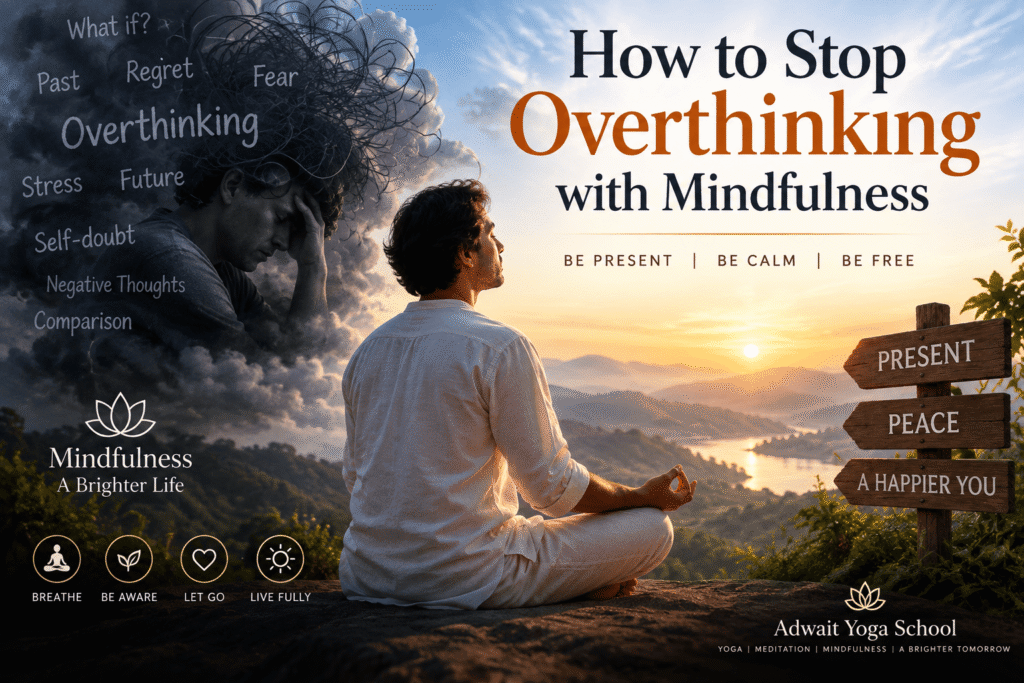
Overthinking has become one of the most common mental habits of modern life. Many people are physically present in one place, but mentally they are continuously moving between the past and the future. They keep replaying old conversations, imagining future problems, doubting their decisions, comparing themselves with others, and creating many unnecessary stories in the mind.
Sometimes overthinking looks like planning, but actually it is not planning. Planning gives clarity. Overthinking creates confusion. Planning gives direction. Overthinking creates fear. Planning helps us act wisely. Overthinking keeps us trapped in mental loops.
A person who overthinks may feel tired even after resting. The body may be sitting quietly, but the mind is running like a machine. Thoughts keep coming one after another. “What if this happens?” “Why did I say that?” “What will people think?” “Did I make the right choice?” “What if I fail?” “What if I lose something?” Slowly, the mind becomes heavy, restless, anxious, and exhausted.
Mindfulness gives us a very practical and powerful way to come out of this habit. It does not fight with thoughts. It does not force the mind to become blank. It simply teaches us to become aware of thoughts without becoming lost in them.
What Is Overthinking?
Overthinking means thinking more than necessary, especially about things that cannot be changed or are not yet happening. It is a repetitive mental pattern where the mind keeps circling around the same worry, fear, regret, or possibility.
For example, after a simple conversation, the mind may keep replaying it for hours: “Did I speak correctly? Did that person misunderstand me? Should I have said something different?” Or before an important event, the mind may create many imaginary negative outcomes: “What if I fail? What if people judge me? What if something goes wrong?”
This kind of thinking does not solve the problem. It only increases inner pressure.
Overthinking is often connected with fear, insecurity, perfectionism, attachment, lack of trust, and past emotional experiences. The mind tries to protect us by predicting danger, but when this habit becomes excessive, it creates unnecessary suffering.
Why Does the Mind Overthink?
The mind overthinks because it wants certainty. It wants to control everything. It wants to avoid pain, failure, rejection, insult, loss, and uncertainty. But life cannot be controlled completely. The more the mind tries to control the uncontrollable, the more restless it becomes.
Overthinking also happens because the mind is not trained to stay in the present moment. When awareness is weak, thoughts become strong. The mind keeps moving automatically according to old habits and impressions.
In yogic language, we may say that overthinking is the movement of chitta vrittis — the modifications and fluctuations of the mind. These vrittis are shaped by memories, desires, fears, samskaras, attachments, and imagination. When these mental waves are not observed consciously, they keep disturbing inner peace.
Mindfulness helps by training awareness. When awareness becomes stronger, thoughts lose their unconscious power.
What Is Mindfulness?
Mindfulness means being aware of the present moment with clarity, acceptance, and non-judgment. It is the art of knowing what is happening inside and outside, without immediately reacting to it.
When you breathe and know that you are breathing, this is mindfulness. When a thought arises and you know that thinking is happening, this is mindfulness. When anxiety appears and you observe it gently in the body, this is mindfulness. When you are walking and fully aware of each step, this is mindfulness.
Mindfulness is not only meditation. It is a way of living with awareness.
In mindfulness, we do not suppress thoughts. We do not fight with emotions. We do not force positivity. We simply learn to see clearly. This seeing itself becomes healing.
How Mindfulness Helps Stop Overthinking
Mindfulness helps stop overthinking by changing our relationship with thoughts. Normally, when a thought comes, we immediately believe it. If the mind says, “Something bad will happen,” we become afraid. If the mind says, “I made a mistake,” we feel guilty. If the mind says, “People will judge me,” we become anxious.
Mindfulness teaches us: a thought is only a thought. It may be useful, or it may not be useful. It may be true, or it may be only imagination. We do not need to believe every thought.
This is a very important understanding.
The mind produces thoughts just as the sky carries clouds. Some thoughts are clear. Some are heavy. Some are beautiful. Some are dark. But the sky is not destroyed by clouds. Similarly, awareness is not destroyed by thoughts.
When we practice mindfulness, we learn to become the observer of thoughts. Slowly, thoughts may still come, but they do not control us in the same way.
The First Step: Recognize That You Are Overthinking
Most people overthink unconsciously. They do not realize they are trapped until they become tired, anxious, irritated, or emotionally heavy.
The first step is simple recognition.
You may say to yourself, “Overthinking is happening.”
This small sentence creates distance. Instead of saying, “I am overthinking and I cannot stop,” simply say, “Overthinking is happening in the mind.”
This is the beginning of witness awareness.
When you recognize overthinking, you are no longer fully trapped in it. A part of you has awakened as the observer.
Come Back to the Breath
Breath is one of the simplest and most powerful tools to stop overthinking. Thoughts live in the mind, but breath brings awareness back to the body and present moment.
Whenever you notice overthinking, pause for a few moments.
Inhale slowly.
Exhale gently.
Feel the breath entering and leaving the nostrils.
Do not try to control the breath too much. Just become aware of it.
You can practice this for one minute, three minutes, or five minutes. Even a few conscious breaths can break the chain of repetitive thinking.
The breath is always in the present. You cannot breathe in the past. You cannot breathe in the future. So when you return to the breath, you return to the present moment.
Name the Thought Pattern
Mindfulness becomes stronger when we learn to name our mental patterns. Instead of getting lost in the content of thoughts, we identify the type of thinking.
For example:
“This is worry.”
“This is fear.”
“This is planning.”
“This is regret.”
“This is comparison.”
“This is self-criticism.”
“This is imagination.”
“This is memory.”
This naming is not judgment. It is clarity.
When you name the pattern, the mind becomes less confused. You begin to understand what is happening. You are not fighting the thought, but you are not blindly following it either.
This simple practice is very helpful for people who get trapped in anxiety and repeated mental stories.
Shift from Thinking to Feeling
Overthinking often happens because we remain too much in the head. The mind keeps analysing, explaining, predicting, and judging. But many thoughts are actually covering emotions.
Behind overthinking, there may be fear. Behind repeated planning, there may be insecurity. Behind self-criticism, there may be shame. Behind anger, there may be hurt. Behind control, there may be anxiety.
Mindfulness invites us to ask: “What am I feeling in the body right now?”
Close your eyes for a moment and feel the body.
Is there tightness in the chest?
Is there pressure in the head?
Is there heaviness in the stomach?
Is the breath shallow?
Are the shoulders tense?
When awareness moves from thinking to feeling, the emotional energy begins to soften. You are no longer only feeding thoughts. You are meeting the deeper emotion with presence.
Practice the Mindful Pause
A mindful pause is a short break between thought and reaction. It is very useful in daily life.
Before replying to a message, pause.
Before reacting in anger, pause.
Before making a decision from fear, pause.
Before believing a negative thought, pause.
In that pause, take one conscious breath and ask: “What is actually needed now?”
Overthinking creates impulsive or confused reactions. Mindful pause creates wise response.
This simple practice can transform relationships, work decisions, emotional habits, and spiritual life.
Observe Thoughts Like Passing Clouds
One of the most beautiful mindfulness practices is to observe thoughts like clouds passing through the sky. Sit quietly. Close your eyes. Let the breath be natural.
As thoughts arise, do not follow them. Do not push them away. Just notice: “A thought has come.”
Let it pass.
Another thought comes. Notice it.
Let it pass.
Some thoughts will pull you. That is natural. The moment you realize you are lost, gently come back to awareness.
This practice trains the mind not to cling to every thought. Slowly, the space between thoughts becomes more visible. In that space, peace begins to appear.
Use the Body as an Anchor
The body is always present. Overthinking pulls us into mental stories, but body awareness brings us back to reality.
You can use any body sensation as an anchor.
Feel your feet touching the ground.
Feel your hands resting on your lap.
Feel the movement of the abdomen while breathing.
Feel the posture of the spine.
Feel the contact of clothes on the skin.
This may look very simple, but it is powerful. When awareness is rooted in the body, the mind becomes less scattered.
Especially during stress, grounding through the body helps reduce mental speed and emotional reactivity.
Reduce Mental Noise
Mindfulness is not only what we do during meditation. It is also how we live throughout the day. If we continuously feed the mind with social media, unnecessary debates, negative news, comparison, gossip, and digital stimulation, overthinking naturally increases.
The mind needs rest.
Create small spaces of silence during the day.
Do not check the phone immediately after waking up.
Eat one meal without watching anything.
Take a short walk without headphones.
Sit quietly for five minutes before sleeping.
Spend time in nature.
These small practices reduce mental noise and make mindfulness easier.
A mind that is constantly overloaded cannot become peaceful simply by sitting for five minutes. Daily lifestyle also matters.
Mindfulness of Daily Activities
You can stop overthinking not only by sitting meditation, but also through mindful living.
When you drink tea, just drink tea.
When you walk, just walk.
When you eat, just eat.
When you listen, fully listen.
When you work, do one task with complete attention.
This is very important in Indian spiritual life also. Mindfulness is not separate from karma. Every action can become meditation if it is done with awareness.
When the mind learns to stay with one activity at a time, overthinking reduces naturally. Scattered attention creates scattered thoughts. Focused awareness creates mental stability.
Write Down the Thoughts
Sometimes the mind overthinks because thoughts remain unorganized. Writing can help.
Take a notebook and write down what is disturbing you. Do not write beautifully. Just empty the mind.
Then ask three questions:
What is the real issue?
What can I do practically?
What is not in my control?
This brings clarity.
Mindfulness does not mean we avoid practical action. It means we see clearly what can be done and what must be accepted.
When you separate action from imagination, overthinking reduces.
Accept Uncertainty
Many people overthink because they cannot tolerate uncertainty. They want to know exactly what will happen. But life does not work like that.
Mindfulness teaches us to live with uncertainty more peacefully.
We learn to say: “I do not know everything, and that is okay.”
This does not mean carelessness. It means trust. We do our best in the present moment and allow life to unfold.
Overthinking says, “Control everything.”
Mindfulness says, “Be aware, act wisely, and let go.”
This letting go is not weakness. It is intelligence.
From Reaction to Response
Overthinking often leads to reaction. We react to imaginary fears, old memories, emotional wounds, and assumptions. But mindfulness gives us the power to respond.
Reaction comes from unconscious habit.
Response comes from awareness.
For example, if someone does not reply to your message, overthinking may say, “They are ignoring me. They don’t respect me. Something is wrong.” But mindfulness says, “A thought of insecurity has arisen. Let me wait. Let me not create a story immediately.”
This one shift can save us from unnecessary pain.
Mindfulness and Self-Compassion
Overthinkers are often very hard on themselves. They judge their thoughts, emotions, mistakes, and weaknesses. This self-judgment increases overthinking.
Mindfulness must be joined with compassion.
When you notice overthinking, do not say, “Why am I like this?” Instead say, “My mind is tired. Let me be gentle with myself.”
Place one hand on the heart. Take a slow breath. Feel kindness toward yourself.
A harsh mind cannot heal a restless mind. Only a compassionate awareness can bring deep relaxation.
A Simple 10-Minute Mindfulness Practice to Stop Overthinking
Sit comfortably. Keep the spine relaxed and steady. Close your eyes gently.
For the first two minutes, simply notice your natural breath.
For the next two minutes, feel the body sitting. Feel the ground, hands, shoulders, and face.
For the next three minutes, observe thoughts. Whenever a thought comes, name it gently: “thinking,” “worry,” “memory,” “planning.” Then return to the breath.
For the next two minutes, observe any emotion in the body. Do not judge it. Just feel and breathe.
For the last one minute, silently repeat: “I am here. I am aware. I choose peace.”
Open the eyes slowly.
Practice this daily. Regularity is more important than duration.
What to Do When Overthinking Comes at Night
Night-time overthinking is very common. The body is tired, but the mind becomes active. At night, the nervous system may replay unfinished emotions and worries.
Before sleeping, reduce screen use. Sit quietly for a few minutes. Take slow breaths. Write down pending tasks for tomorrow. Then tell the mind, “This can wait.”
You can also practice body scan. Start from the feet and move awareness slowly upward. Relax each part of the body. This brings attention away from thought and into sensation.
Do not fight with sleep. Just relax the body and observe the breath. Sleep comes more easily when the mind stops struggling.
Learn Mindfulness with Adwait Yoga School
Those who want to learn mindfulness in a deeper, systematic, and guided way can explore the Mindfulness Teacher Training Course at Adwait Yoga School.
Adwait Yoga School offers a certified mindfulness teacher training program in India with a structured three-level curriculum for those who want to become mindfulness teachers or integrate mindfulness meditation deeply into daily life. The training includes authentic mindfulness tools, practical techniques, conscious communication, compassion, emotional intelligence, and the art of guiding others with awareness.
You can visit the course page here:
The school also offers separate mindfulness levels. Level 1 is suitable for beginners and introduces essential mindfulness tools, meditation techniques, and mindfulness-based interventions. Level 2 focuses on deeper psychological aspects, emotional resilience, conscious communication, and in-depth mindfulness-based interventions. Level 3 is an advanced mindfulness training course that includes advanced mindfulness tools, mindfulness-based interventions, teaching methodology, and practices such as compassion, MBSR, MBCT, and letting go.
Learning under proper guidance is helpful because overthinking is not only a mental habit. It is connected with emotions, body patterns, breath, nervous system, and unconscious impressions. A guided mindfulness training can help students understand the mind more deeply and develop practical tools for daily life.
Final Thoughts
Overthinking cannot be stopped by fighting with the mind. The more we fight thoughts, the more powerful they become. Mindfulness gives another path. It teaches us to observe thoughts, return to the breath, feel the body, name the pattern, pause before reacting, and live more consciously.
The goal is not to make the mind permanently blank. The goal is to become free from the habit of believing every thought.
Thoughts may come. Let them come.
Worries may arise. Observe them.
Fear may appear. Breathe with it.
Memories may return. Witness them.
Slowly, the mind learns that it does not need to run all the time. Awareness becomes stronger. The breath becomes deeper. The body becomes more relaxed. Decisions become clearer. Life becomes simpler.
Mindfulness brings us back from the noise of imagination to the truth of the present moment.
And in the present moment, overthinking begins to lose its power.