
In the yogic and tantric tradition of India, human life is not seen only as a physical process. We are not just bones, muscles, organs, and nerves. We are also breath, prana, emotions, thoughts, memories, samskaras, awareness, and consciousness. The body is visible, but behind the visible body there is a subtle energy system that supports our physical, emotional, mental, and spiritual life.
One of the most important parts of this subtle energy system is the chakra system.
Chakras are energy centers in the subtle body. They are not physical organs, but they are connected with different areas of the body, emotional patterns, mental tendencies, and stages of spiritual growth. When the chakras are balanced, energy flows more harmoniously. A person may feel grounded, creative, confident, loving, expressive, intuitive, and spiritually connected. When a chakra is blocked or imbalanced, some area of life may feel disturbed.
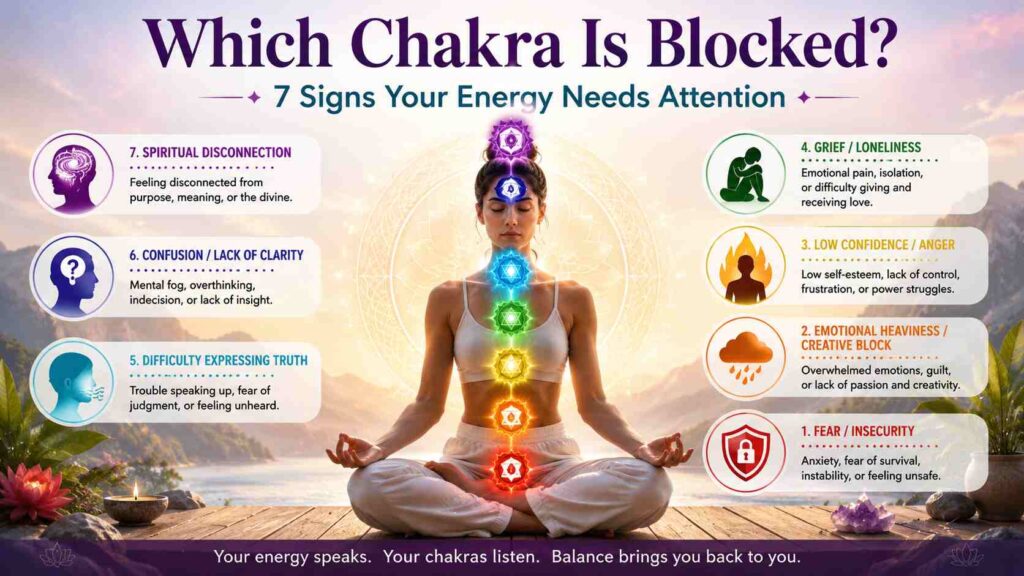
Many people ask, “Which chakra is blocked in me?” This question usually comes when they feel stuck in life. They may feel fearful, emotionally heavy, low in confidence, unable to express themselves, disconnected from love, confused in decisions, or spiritually dry. Sometimes the body also gives signals through tightness, heaviness, poor energy, or discomfort.
It is important to understand that chakra imbalance should not be used as a replacement for medical diagnosis. Physical or mental health concerns should be treated responsibly. But from a holistic yogic view, chakra awareness can help us understand deeper patterns of energy, emotion, and consciousness.
So let us understand the seven main chakras and the common signs that your energy needs attention.
What Does It Mean When a Chakra Is Blocked?
A blocked chakra does not mean that there is a physical object blocking energy like a stone in a pipe. It means that the pranic flow in that energy center is disturbed, weak, excessive, suppressed, or imbalanced.
This imbalance may happen because of many reasons: fear, trauma, stress, negative thinking, unhealthy lifestyle, emotional suppression, wrong food, lack of movement, lack of spiritual practice, disturbed relationships, excessive desire, ego, guilt, grief, or lack of self-awareness.
Sometimes a chakra may be underactive. In that case, the qualities of that chakra feel weak. Sometimes it may be overactive. In that case, the qualities become excessive, uncontrolled, or imbalanced.
For example, a weak Manipura Chakra may show as low confidence and lack of willpower. But an overactive Manipura may show as control, anger, domination, or ego. A blocked Anahata may show as emotional closure, but an imbalanced heart may also show as over-giving without boundaries.
So the goal is not simply to “open” chakras aggressively. The goal is balance.
In chakra healing, balance is more important than excitement.
1. Muladhara Chakra: When You Feel Unsafe or Ungrounded

Muladhara Chakra, or the root chakra, is located at the base of the spine. It is connected with grounding, survival, security, stability, body awareness, discipline, and our relationship with the earth.
When Muladhara is balanced, a person feels stable, practical, patient, grounded, and safe within the body. There is a feeling of inner strength. Such a person can handle daily life with steadiness. They are not easily shaken by every situation.
When Muladhara is blocked or imbalanced, common signs may include fear, insecurity, anxiety, restlessness, financial worry, lack of stability, difficulty maintaining routine, feeling disconnected from the body, or always expecting something bad to happen.
Physically, some people may feel heaviness in the legs, lower back discomfort, fatigue, or weak body awareness. Again, these may have many causes, so medical care should be taken when needed.
Emotionally, root chakra imbalance often appears as fear of survival. A person may constantly feel, “Will I be okay? Am I safe? Can I trust life?” They may overthink money, shelter, health, and security.
To support Muladhara, grounding practices are helpful. Walking barefoot on natural ground, simple standing asanas, mindful walking, stable daily routine, deep belly breathing, eating nourishing food, and spending time in nature can help. Spiritual discipline also strengthens the root because routine gives safety to the nervous system.
A balanced root is the foundation of all higher spiritual practice. Without grounding, energy work can become unstable.
2. Swadhisthana Chakra: When Emotions Feel Blocked or Uncontrolled

Swadhisthana Chakra, or the sacral chakra, is located in the lower abdomen. It is connected with emotions, creativity, fluidity, pleasure, relationships, sexuality, adaptability, and the ability to feel life.
When Swadhisthana is balanced, emotions flow naturally. A person can feel joy, creativity, intimacy, and healthy pleasure without becoming addicted or uncontrolled. There is flexibility in life. The person can relate to others with warmth and sensitivity.
When Swadhisthana is blocked, common signs may include emotional numbness, guilt, creative block, fear of intimacy, difficulty enjoying life, shame around feelings, or suppression of desire. When it is overactive, signs may include emotional drama, attachment, dependency, excessive pleasure-seeking, mood swings, or difficulty with boundaries.
This chakra is deeply connected with water element. Just as water needs to flow, emotions also need healthy movement. When emotions are suppressed for long, the sacral energy becomes heavy. When emotions are uncontrolled, the water becomes like a flood.
To support Swadhisthana, gentle hip-opening yoga, creative expression, journaling, mindful movement, dance, emotional honesty, and water meditation may help. Sitting quietly and asking, “What am I feeling?” can also be very powerful.
Sacral chakra healing is not about indulging every desire. It is about developing a healthy relationship with feeling, creativity, and emotional flow.
3. Manipura Chakra: When Confidence and Willpower Are Weak
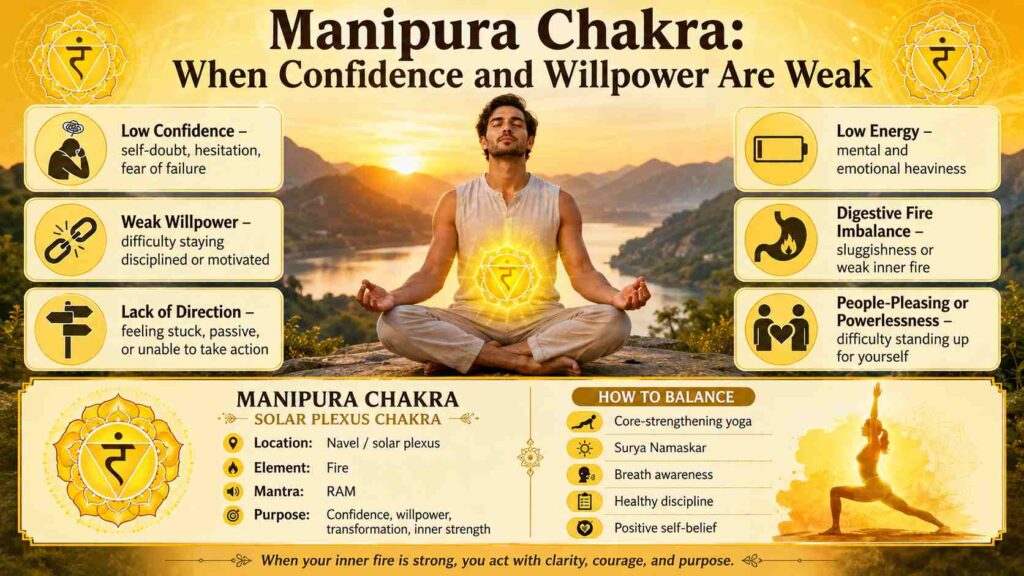
Manipura Chakra is located around the navel and solar plexus area. It is connected with fire, digestion, discipline, self-confidence, willpower, transformation, courage, and personal power.
When Manipura is balanced, a person has healthy confidence. They can take action, make decisions, maintain discipline, digest experiences, and transform challenges into strength. They do not need to dominate others, but they also do not remain weak.
When Manipura is blocked or weak, common signs may include low confidence, indecision, laziness, poor motivation, fear of failure, lack of discipline, low self-esteem, or feeling powerless. When Manipura is overactive, signs may include anger, control, pride, criticism, impatience, domination, or excessive ambition.
Manipura is the inner fire. If the fire is too weak, life feels dull. If the fire is too strong, it burns others and oneself. Balanced fire gives clarity, strength, and transformation.
To support Manipura, practice core-strengthening asanas, Surya Namaskar, mindful discipline, Kapalabhati only if suitable, Agni Sara under guidance, and conscious goal-setting. Even keeping small promises to yourself strengthens Manipura. For example, practicing yoga daily for 15 minutes can build inner fire.
A balanced Manipura helps us live with courage and responsibility.
4. Anahata Chakra: When Love Feels Heavy or Closed
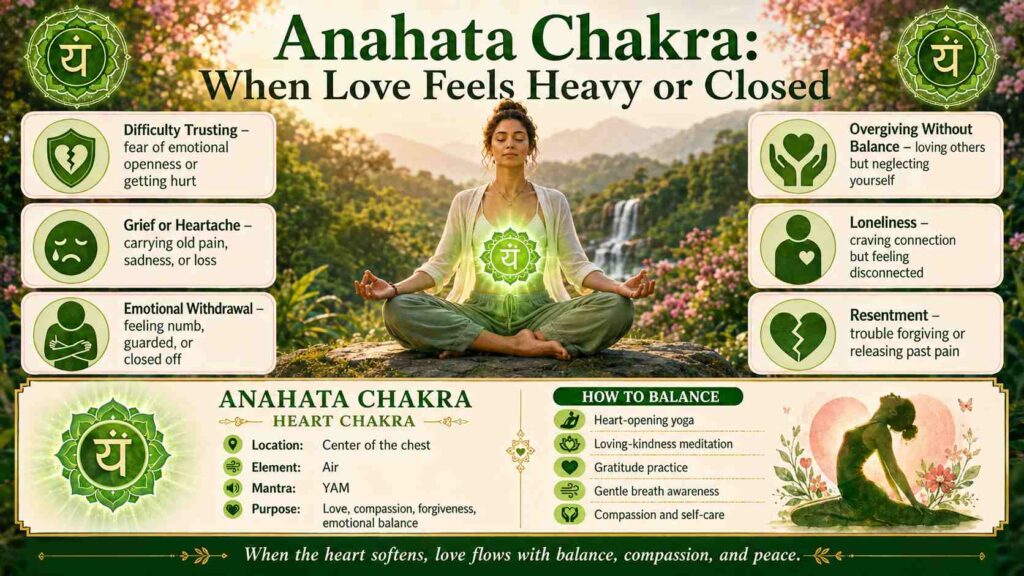
Anahata Chakra is located at the heart center. It is connected with love, compassion, forgiveness, devotion, grief, empathy, acceptance, and emotional healing.
When Anahata is balanced, a person can love without losing themselves. They can give and receive. They can forgive, but they also maintain healthy boundaries. Compassion becomes natural. Devotion opens. The heart feels soft but strong.
When Anahata is blocked, common signs may include emotional coldness, difficulty trusting, fear of love, grief, resentment, loneliness, bitterness, or inability to forgive. When the heart is imbalanced in an excessive way, a person may over-give, become emotionally dependent, ignore boundaries, or constantly seek approval through love.
Heart chakra pain is very common because almost every person carries some emotional wound. Loss, rejection, betrayal, family hurt, loneliness, or disappointment can close the heart.
To support Anahata, practice heart-opening asanas, loving-kindness meditation, mantra chanting, gratitude, forgiveness practices, and compassionate service. Even placing the hand on the heart and breathing gently can soften emotional heaviness.
But forgiveness should not be forced. The heart opens gradually when it feels safe.
A balanced heart is one of the most beautiful signs of spiritual growth.
5. Vishuddha Chakra: When You Cannot Express Your Truth

Vishuddha Chakra is located at the throat. It is connected with speech, truth, expression, sound, purification, communication, listening, and authenticity.
When Vishuddha is balanced, a person speaks clearly, truthfully, and kindly. They can express their needs without aggression. They can listen deeply. Their speech carries sincerity. Silence also becomes meaningful.
When Vishuddha is blocked, common signs may include fear of speaking, suppressed truth, weak communication, throat tightness, difficulty expressing emotions, feeling unheard, or always adjusting to please others. When overactive, it may show as excessive talking, harsh words, gossip, argument, or speaking without awareness.
The throat chakra is not only about talking. It is also about purified expression. Sometimes silence is also Vishuddha. If we speak truth without compassion, it is not balanced. If we remain silent out of fear, it is also not balanced.
To support Vishuddha, practice mantra chanting, Om chanting, Bhramari Pranayama, mindful speech, journaling, and honest communication. Before speaking, ask: Is it true? Is it necessary? Is it kind?
A balanced throat transforms speech into healing.
6. Ajna Chakra: When Clarity and Intuition Feel Clouded
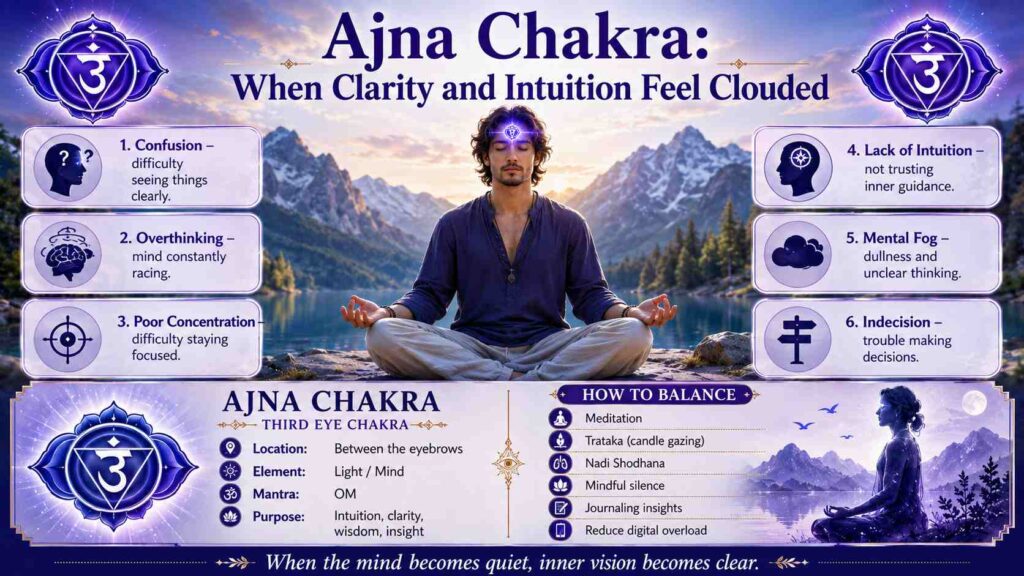
Ajna Chakra is located between the eyebrows. It is often called the third eye. It is connected with intuition, concentration, insight, inner vision, wisdom, discrimination, and mental clarity.
When Ajna is balanced, a person has clear perception. They can see beyond surface appearances. Their intuition is refined, but they are not lost in fantasy. They have focus, inner guidance, and spiritual discrimination.
When Ajna is blocked, common signs may include confusion, lack of clarity, poor concentration, overthinking, difficulty making decisions, feeling disconnected from intuition, or being trapped in mental noise. When overactive or imbalanced, it may show as fantasy, spiritual imagination, ego around visions, or inability to stay grounded.
Ajna needs both intuition and discrimination. Not every inner image is divine guidance. Not every thought is insight. A balanced third eye sees clearly without ego.
To support Ajna, practice Trataka, breath awareness, meditation, mantra japa, journaling insights, and reducing digital overstimulation. Silence is very helpful for Ajna because constant sensory input clouds perception.
A balanced Ajna brings inner guidance, but also humility.
7. Sahasrara Chakra: When You Feel Spiritually Disconnected
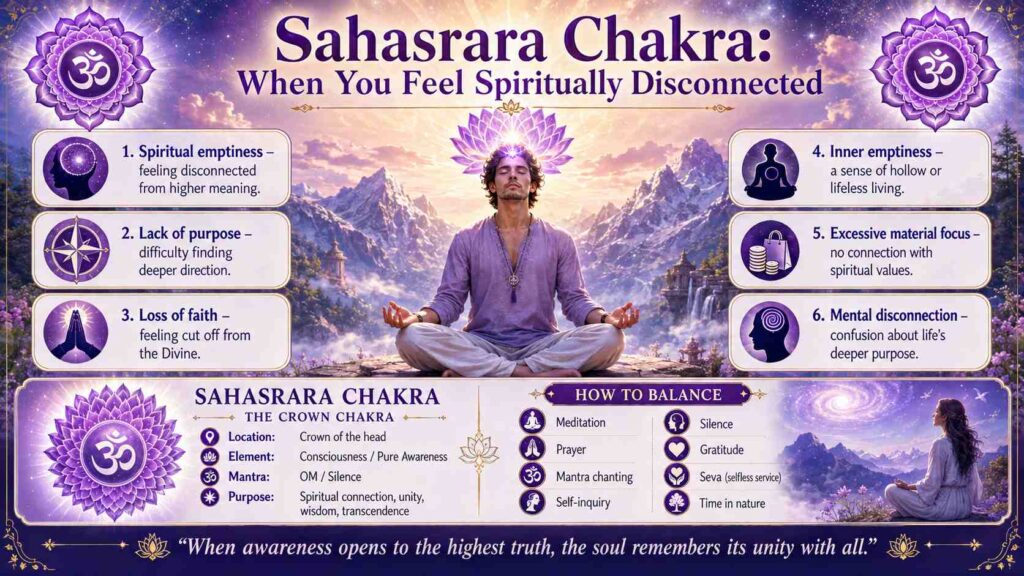
Sahasrara Chakra is located at the crown of the head. It is connected with spiritual awareness, divine connection, surrender, unity, silence, wisdom, and higher consciousness.
When Sahasrara is balanced, a person feels connected with something greater than the personal ego. There is faith, humility, peace, devotion, and openness to higher truth. The person does not feel isolated from life.
When Sahasrara is blocked, common signs may include spiritual dryness, meaninglessness, lack of faith, excessive materialism, inner emptiness, or feeling disconnected from the Divine. When imbalanced in an ungrounded way, it may show as escapism, spiritual pride, fantasy, or neglect of practical life.
Sahasrara should not be forced open. It blossoms naturally when lower chakras are balanced, mind is purified, and meditation deepens.
To support Sahasrara, practice meditation, prayer, chanting, self-inquiry, surrender, study of wisdom texts, and silent sitting. Seva, or selfless service, is also important because it dissolves ego and opens the heart.
A balanced crown does not make us run away from life. It helps us live life with higher awareness.
How to Know Which Chakra Needs Attention
To understand which chakra needs attention, observe your life honestly. Ask yourself:
Where do I feel most stuck?
Is it fear and insecurity? Then Muladhara may need attention.
Is it emotional heaviness or creative block? Then Swadhisthana may need attention.
Is it low confidence or excessive anger? Then Manipura may need attention.
Is it grief, resentment, or difficulty loving? Then Anahata may need attention.
Is it suppressed truth or harsh speech? Then Vishuddha may need attention.
Is it confusion or lack of intuition? Then Ajna may need attention.
Is it spiritual disconnection or lack of meaning? Then Sahasrara may need attention.
But remember, chakras are interconnected. A problem in one chakra can affect others. For example, fear in Muladhara may weaken Manipura confidence. Heart pain may affect Vishuddha expression. Overthinking may disturb Ajna and also weaken grounding.
Therefore, a holistic approach is best.
Do Not Rush to Open Chakras
Today, many people want quick chakra opening. They search for powerful techniques, instant activations, or dramatic experiences. But in traditional yoga, chakra healing is gradual.
Opening a chakra without purification can bring imbalance. For example, activating Manipura without ethics may increase ego. Opening Ajna without grounding may create fantasy. Activating Anahata without boundaries may increase emotional sensitivity.
The goal is not fast opening. The goal is balanced awakening.
A flower opens naturally when sunlight, water, soil, and time are right. Chakras also open naturally with correct practice, lifestyle, awareness, and grace.
Daily Practices for Chakra Balance
You can support chakra balance through simple daily practices.
Practice grounding through walking, stable asanas, and routine.
Practice emotional awareness through journaling and mindful breathing.
Practice inner strength through discipline and core-centered asanas.
Practice heart healing through gratitude and compassion.
Practice throat purification through mantra and mindful speech.
Practice Ajna clarity through meditation and Trataka.
Practice crown connection through prayer, surrender, and silence.
Food, sleep, relationships, work habits, and digital discipline also matter. Chakra healing is not only done during a session. It is lived daily.
Chakra Healing and Meditation
Meditation is one of the best practices for chakra awareness. When we sit quietly, we begin to observe the body, breath, emotions, thoughts, and energy. We become sensitive to where energy feels blocked or flowing.
A simple chakra meditation can be practiced by sitting comfortably, bringing awareness from the root to the crown, and gently observing each center without forcing anything. You may breathe into each chakra area and silently repeat qualities such as safety, flow, strength, love, truth, clarity, and surrender.
Do not try to create sensations. Just observe with awareness.
The deepest healing comes when awareness touches energy.
Learn Chakra Healing with Adwait Yoga School
Those who want to understand chakra imbalance, energy flow, and healing methods in a systematic way can explore the Chakra Healing Teacher Training Course offered by Adwait Yoga School.
Adwait Yoga School offers Chakra Healing Training Courses designed for both beginners and experienced practitioners. The school describes its Chakra Healing Course India as an immersive training under the guidance of Sri Yogi Anand, focusing on the seven chakras, chakra imbalances, energy work, and healing modalities to restore balance in body, mind, and spirit. (adwaityoga.com)
You can visit the Chakra Healing Teacher Training Course page here:
Learning chakra healing through a structured course helps students understand the chakra system, chakra blockages, meditation, energy balancing, healing tools, safe practice, and teaching methodology. Adwait Yoga School also offers specific 50-hour, 100-hour, 200-hour, 300-hour, and 500-hour Chakra Healing Course options for different levels of learning and practice. (adwaityoga.com)
Final Thoughts
When a chakra is blocked, life gives signals. Fear may show a root imbalance. Emotional heaviness may show sacral imbalance. Low confidence may show Manipura imbalance. Grief may show heart imbalance. Suppressed truth may show throat imbalance. Confusion may show Ajna imbalance. Spiritual emptiness may show crown imbalance.
But these signs should be understood with sensitivity, not fear. A blocked chakra does not mean something is wrong with you. It means some part of your energy needs attention, care, awareness, and healing.
Chakra healing is not about becoming dramatic or mystical. It is about becoming balanced, healthy, conscious, loving, grounded, expressive, intuitive, and spiritually connected.
Begin simply. Breathe. Observe. Meditate. Live ethically. Speak truthfully. Rest properly. Spend time in nature. Chant. Practice yoga. Serve with love. Study yourself.
When awareness grows, energy begins to heal.
When energy heals, life begins to flow.
And when life flows with balance, the chakras become not just energy centers, but sacred gateways to inner transformation.