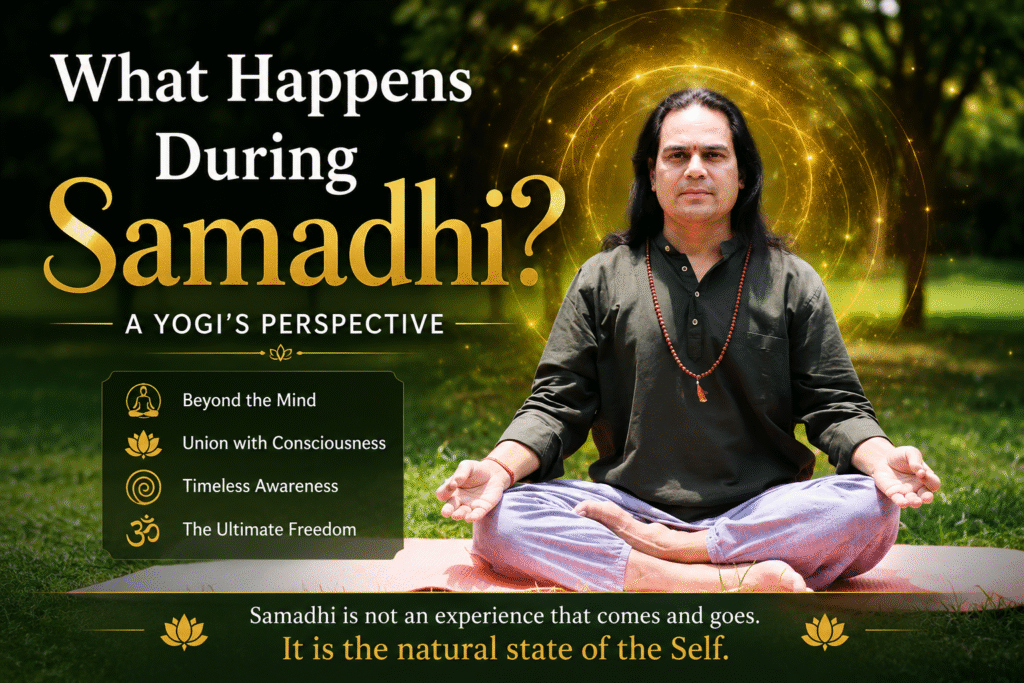
In the journey of Yoga, Samadhi is considered the highest and most sacred state of inner realization. Many people hear the word Samadhi and imagine something mysterious, supernatural, or unreachable. Some think it is like unconsciousness. Some think it is like trance. Some think it means leaving the body or entering some magical state. But in the true yogic understanding, Samadhi is not unconsciousness. It is the highest refinement of consciousness.
Samadhi is the state where the fluctuations of the mind become completely still, and the practitioner rests in pure awareness. It is the culmination of deep meditation, concentration, self-discipline, purification, and surrender. In this state, the separation between the meditator, the process of meditation, and the object of meditation begins to dissolve. What remains is direct experience, pure presence, and profound inner absorption.
In the Indian yogic tradition, Samadhi is not treated as an ordinary mental experience. It is the flowering of Yoga. Patanjali’s Yoga Sutras describe Yoga as “Yogas chitta vritti nirodhah” — Yoga is the cessation of the modifications of the mind. When these mental modifications become still, the seer rests in its own true nature. This resting in one’s true nature is the essence of Samadhi.
From a yogi’s perspective, Samadhi is not something to be collected like an achievement. It is not an ego decoration. It is not a spiritual certificate. It is the natural state that reveals itself when the restless movements of mind, ego, desire, fear, and identification become quiet.
What is Samadhi?
The word Samadhi comes from Sanskrit. It can be understood as complete absorption, total integration, or perfect meditative union. “Sam” means together or complete. “A” means toward. “Dha” means to place or hold. So Samadhi suggests a state where consciousness is completely collected and placed in one-pointed absorption.
In normal life, the mind is scattered. It runs toward many objects — work, family, future, past, desires, fears, memories, imagination, opinions, and emotions. Because the mind is divided, energy is divided. Because energy is divided, awareness becomes weak and fragmented.
In Samadhi, this scattering ends. The mind becomes one-pointed, then transparent, and finally silent. Awareness is no longer moving outward through thought and sensory distraction. It becomes established in itself.
This does not mean that the person becomes dull or blank. Rather, Samadhi is a state of heightened clarity. The ordinary mind may become quiet, but awareness becomes more luminous. It is like a lake whose surface has become completely still. When the water is disturbed, it cannot reflect clearly. When it is still, it reflects the sky perfectly.
Samadhi and the Eight Limbs of Yoga
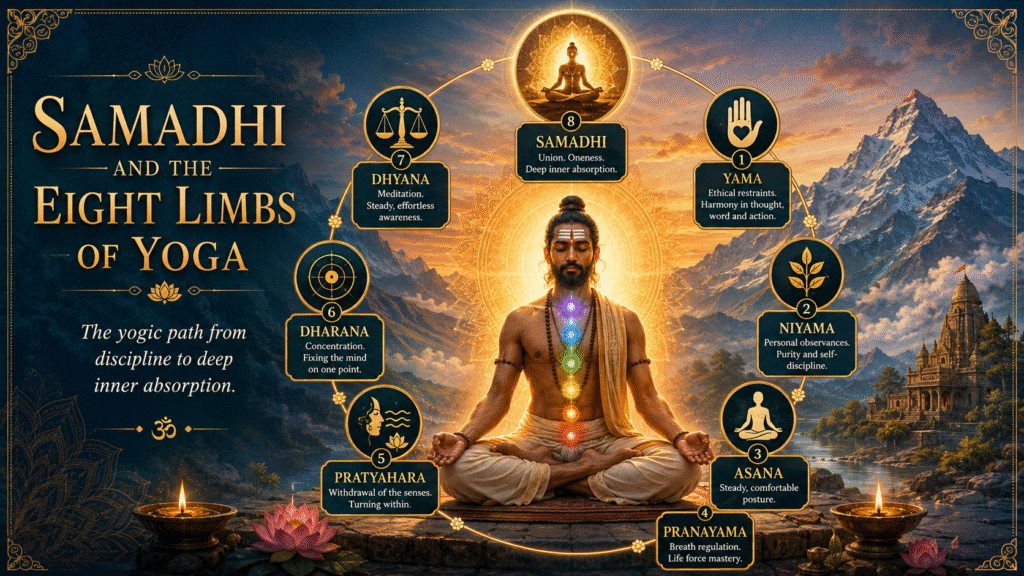
To understand Samadhi properly, we must understand the path that leads to it. In Patanjali’s Ashtanga Yoga, Samadhi is the eighth limb. It does not stand alone. It arises from a complete yogic life.
The eight limbs are Yama, Niyama, Asana, Pranayama, Pratyahara, Dharana, Dhyana, and Samadhi.
Yama and Niyama purify conduct and character. They bring non-violence, truthfulness, self-discipline, purity, contentment, self-study, and surrender into life. Without ethical purification, meditation cannot become deep because guilt, conflict, greed, and ego continue disturbing the mind.
Asana steadies the body. A restless body makes the mind restless. Through asana, the body becomes balanced, relaxed, and capable of sitting steadily.
Pranayama regulates prana, the life-force energy. When prana is disturbed, the mind is disturbed. When breath and prana become balanced, the mind becomes quieter.
Pratyahara withdraws the senses from external objects. The practitioner stops being pulled constantly by sight, sound, taste, touch, and smell.
Dharana is concentration, holding the mind on one object.
Dhyana is meditation, the continuous flow of awareness toward the object.
Samadhi is the complete absorption where even the sense of “I am meditating” begins to dissolve.
So Samadhi is not sudden fantasy. It is the natural flowering of disciplined practice.
What Happens to the Mind During Samadhi?
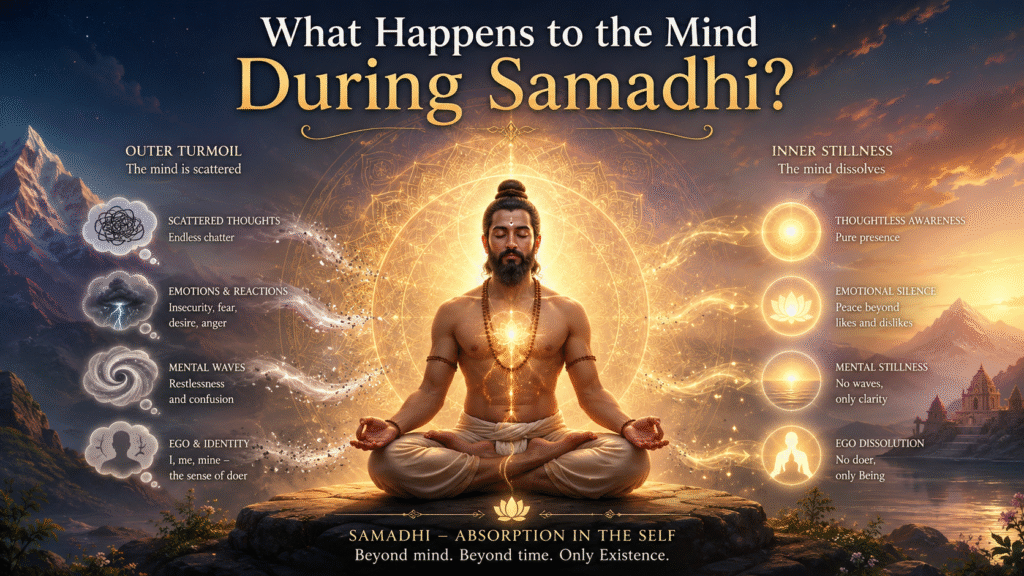
During Samadhi, the normal movement of the mind becomes extremely subtle or completely still. Thoughts may stop, or they may become so transparent that they no longer disturb awareness. The mind does not jump from one object to another. It does not compare, judge, remember, imagine, or react in the ordinary way.
The ego-sense becomes weak. The feeling of “I am doing” reduces. The meditator is no longer fighting with thoughts or trying to meditate. Meditation happens naturally. There is no effort, no struggle, no inner noise.
In ordinary meditation, there is still a practitioner watching the breath, mantra, light, or awareness. In deeper meditation, the watching becomes effortless. In Samadhi, the division between watcher, watching, and watched may dissolve.
This is why yogis say that Samadhi cannot be fully understood intellectually. The intellect can explain the path, but the experience is beyond ordinary conceptual thinking. It is like trying to explain sweetness to someone who has never tasted sugar. Words can guide, but direct experience is needed.
Samadhi is Not Sleep
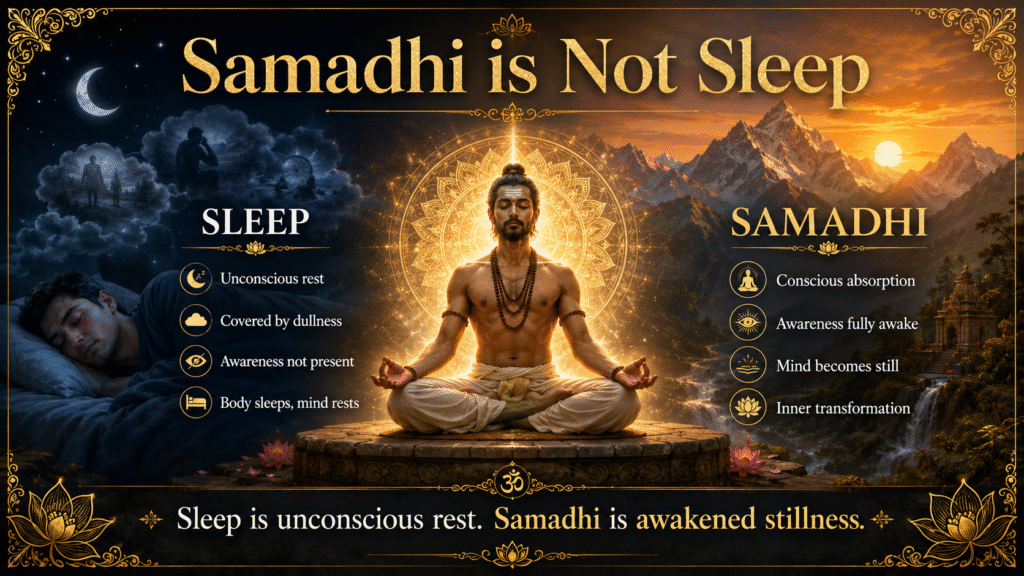
One common misunderstanding is that Samadhi is like sleep. This is not correct. In sleep, awareness is covered by tamas, or dullness. The person is unconscious of body, mind, and surroundings. After sleep, one may feel rest, but there is no clear knowledge of the state while it was happening.
In Samadhi, awareness is not covered. It is awake, luminous, and clear. The body may be still, the breath may be subtle, and the mind may be silent, but consciousness is not lost.
Sleep is unconscious rest. Samadhi is conscious absorption.
Another difference is the effect after the state. After deep sleep, old habits usually remain the same. After true Samadhi, the inner being is transformed. Attachments weaken. Ego becomes softer. Fear reduces. Compassion increases. Wisdom becomes more natural.
This is why Samadhi is considered spiritually significant, not merely relaxing.
Samadhi is Not Escapism
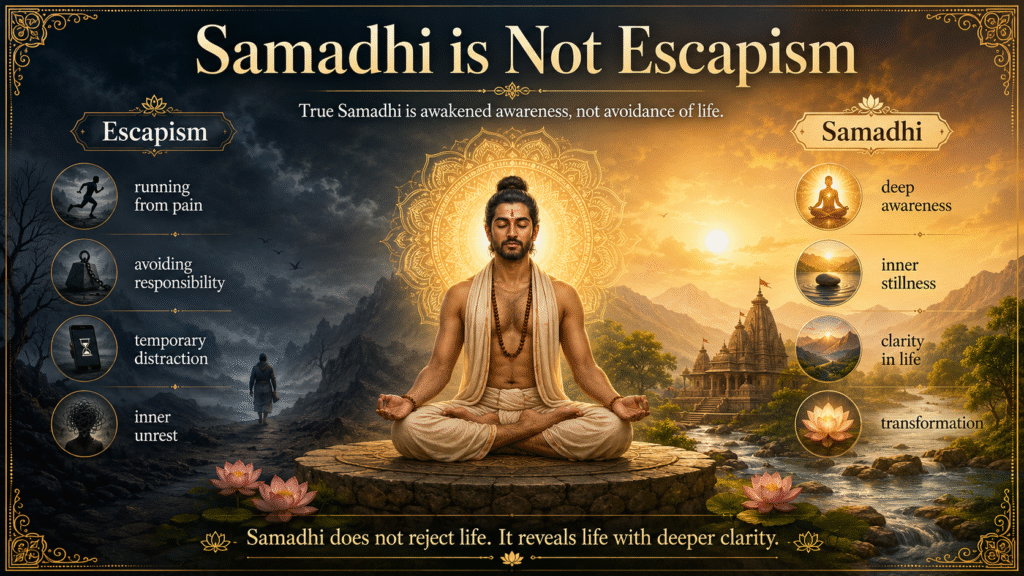
Some people think meditation and Samadhi are escapes from life. But true Samadhi does not make a person weak or irresponsible. It makes the person more clear, stable, compassionate, and wise.
Escapism means running away from life because one cannot face it. Samadhi is not running away. It is going to the root of consciousness. A yogi who touches deeper states of meditation does not reject life out of fear. Rather, he begins to see life more clearly.
When the ego becomes quiet, action becomes purer. When desire reduces, relationships become less possessive. When fear reduces, decisions become wiser. When identification with the mind reduces, suffering reduces.
So Samadhi is not against life. It reveals the deeper foundation of life.
Types of Samadhi
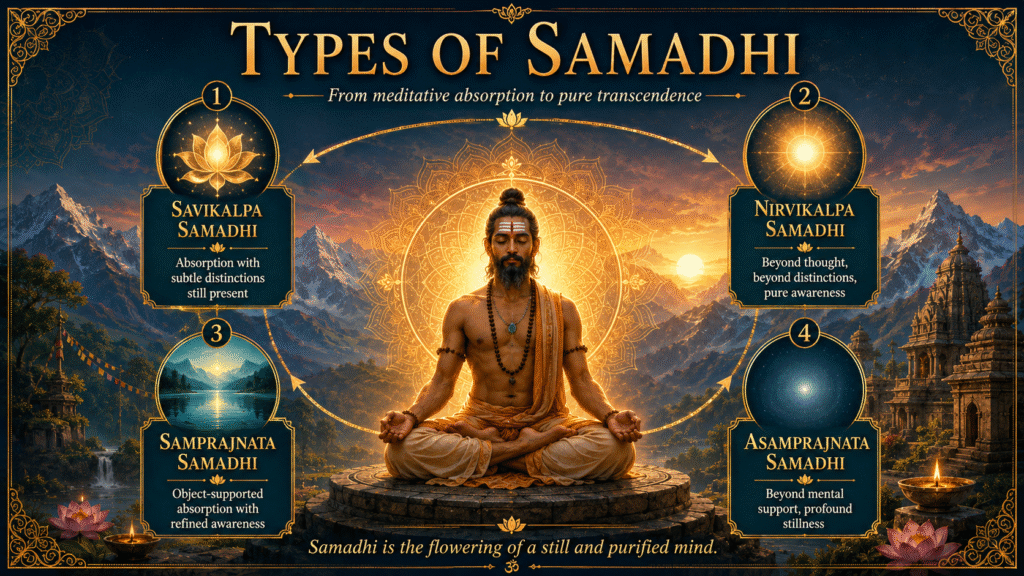
Yogic texts describe different types and stages of Samadhi. These classifications help practitioners understand the journey, but they should not become a matter of ego or imagination.
One important distinction is between Savikalpa Samadhi and Nirvikalpa Samadhi.
Savikalpa Samadhi is a state where some subtle distinction remains. There may still be an object of meditation, such as mantra, light, deity, breath, or subtle awareness. The mind is deeply absorbed, but a refined form of mental awareness remains.
Nirvikalpa Samadhi is considered beyond conceptual distinctions. In this state, the ordinary mental constructs dissolve. There is no object in the usual sense. Only pure awareness remains. It is beyond thought, beyond name and form, beyond the ordinary sense of individuality.
Patanjali also describes Samprajnata and Asamprajnata Samadhi. Samprajnata Samadhi includes subtle awareness of the object and may involve stages related to reasoning, reflection, joy, and pure I-sense. Asamprajnata Samadhi is beyond even these subtle supports.
In Vedanta, Samadhi is often related to direct knowledge of the Self. In Bhakti, deep absorption in the Divine may also become a form of Samadhi. In Tantra, Samadhi may involve awakened prana and union of Shiva and Shakti. In Buddhism, meditative absorption is discussed through jhanas and deeper insight states, though the philosophical framework differs.
The names may differ, but the core direction is the same: the mind becomes purified, concentrated, silent, and free from ordinary bondage.
What Happens to the Body During Samadhi?
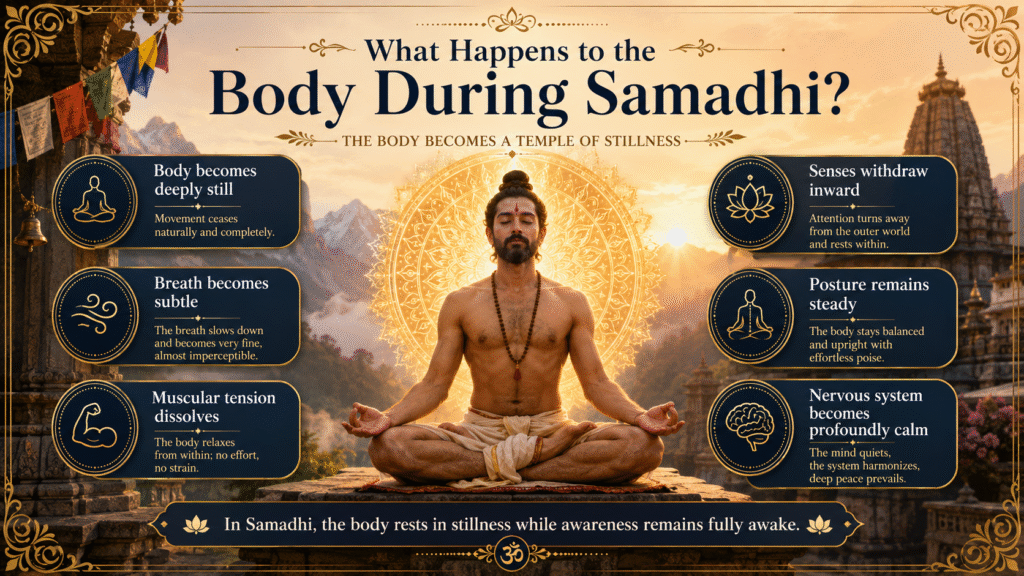
From the outside, a person in deep Samadhi may appear very still. The body may become motionless. The breathing may become very subtle. The face may look peaceful. Sometimes the body may feel light, heavy, expanded, or almost forgotten.
In deep meditation, the nervous system shifts into profound calm. The breath slows down. Muscular tension reduces. The senses become withdrawn. The body is no longer the center of identity.
But one should be careful. Physical stillness alone is not Samadhi. A person may sit still externally while the mind is full of thoughts. Another person may have subtle inner absorption even without dramatic outer signs. Therefore, Samadhi should not be judged only by physical appearance.
True signs are inner transformation, purity, compassion, detachment, steadiness, and freedom from egoic reactivity.
What Happens to the Sense of Self?
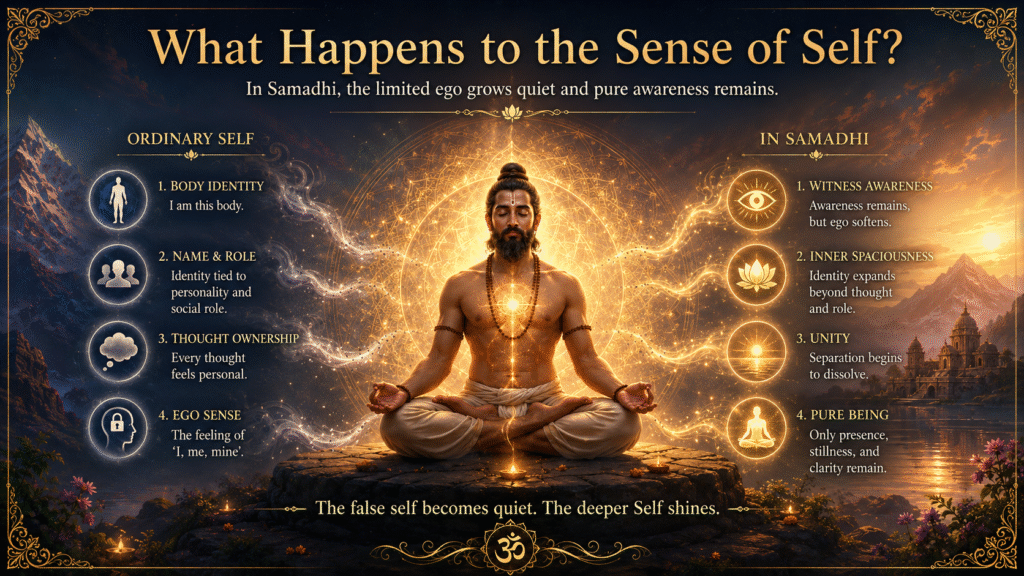
In ordinary life, we identify with the body, name, role, thoughts, emotions, memories, and social identity. We say, “I am this body,” “I am this profession,” “I am happy,” “I am sad,” “I am successful,” “I am insulted,” “I am afraid.”
In Samadhi, this limited identity begins to dissolve. The practitioner may experience that the ordinary “I” is not the final truth. The sense of being a separate ego becomes silent. There may be a profound experience of unity, spaciousness, or pure being.
In some states, the practitioner feels one with the object of meditation. In deeper states, even the object disappears and only awareness remains.
This is why yogis say that Samadhi reveals the difference between the mind and the Self. The mind is changing. The Self is the witness of change. Thoughts come and go. Awareness remains. Emotions come and go. Awareness remains. Body changes. Awareness remains.
Samadhi gives a direct taste of this truth.
Bliss in Samadhi
Many yogic texts describe Samadhi as blissful. This bliss is not ordinary pleasure. Ordinary pleasure depends on objects — food, praise, success, relationship, comfort, or sensory enjoyment. Such pleasure comes and goes.
The bliss of Samadhi is inner, objectless, and quiet. It arises when the mind’s agitation stops. It is not excitement. It is peaceful fullness. It is not emotional thrill. It is deep contentment.
However, even bliss can become an attachment if the practitioner is not careful. Some seekers become attached to meditative experiences. They want to repeat them again and again. This itself becomes a subtle obstacle.
A true yogi does not cling even to bliss. He continues toward truth, freedom, and complete surrender.
The Role of Guru and Guidance
Samadhi is a deep subject, and guidance is very important. Without guidance, seekers may confuse imagination, emotional states, visions, sleep, dissociation, or psychological experiences with Samadhi.
A genuine teacher helps the practitioner remain grounded. He reminds the student that spiritual experiences are not the final goal. Purification of ego, ethical living, humility, compassion, and wisdom are equally important.
In Indian tradition, the Guru is not merely an instructor of technique. The Guru is a guide who has walked the path and can help the disciple avoid confusion. Especially in deeper meditation, Kundalini practices, chakra work, and subtle states of consciousness, proper guidance is essential.
Samadhi should never become a matter of spiritual pride. The moment pride arises, the mind has again created bondage.
Obstacles on the Way to Samadhi
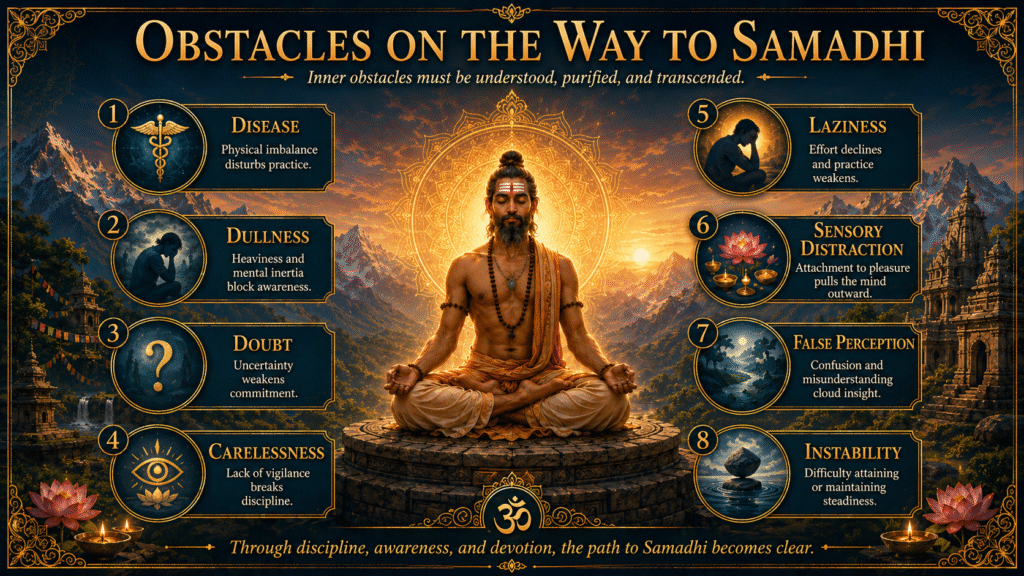
There are many obstacles on the path. Restlessness, laziness, doubt, desire, fear, ego, attachment to experiences, irregular practice, unhealthy lifestyle, and emotional imbalance can disturb meditation.
Patanjali mentions obstacles like disease, dullness, doubt, carelessness, laziness, sensuality, false perception, failure to attain stability, and instability after attainment.
This is why the yogic path emphasizes discipline. Regular practice, right food, right sleep, ethical living, self-study, devotion, and sincere intention are needed.
A seeker should not rush. Samadhi cannot be forced. If one tries to force the mind into silence, tension increases. The path requires patience, devotion, steadiness, and surrender.
Samadhi and Daily Life
The purpose of Samadhi is not only to sit in meditation and enjoy inner states. Its real value is seen in daily life. If meditation makes a person more humble, loving, truthful, fearless, disciplined, and compassionate, then it is moving in the right direction.
A person may talk beautifully about Samadhi, but if he is full of anger, ego, greed, jealousy, and manipulation, then the realization is not mature. True spiritual attainment transforms conduct.
A yogi’s perspective is very simple: inner experience must become outer character.
Samadhi should bring clarity in action, purity in speech, kindness in relationships, and steadiness in difficulty. Otherwise, it remains incomplete.
Samadhi and Modern Science
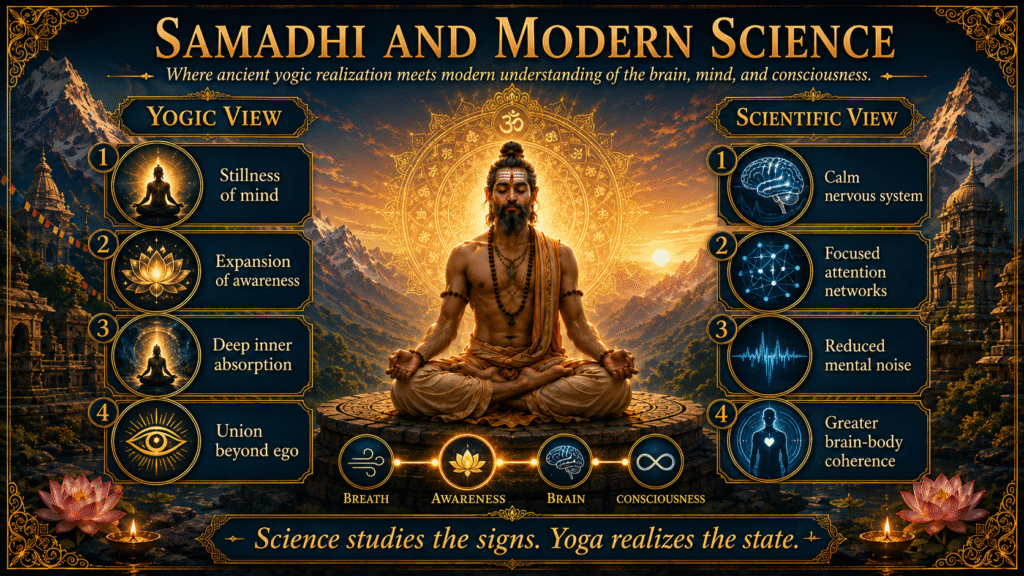
Modern science cannot fully measure Samadhi in the spiritual sense, because Samadhi is a subjective state of consciousness. However, science can study meditation’s effects on the brain, nervous system, breath, attention, and emotional regulation.
Research on meditation suggests that regular practice may influence attention networks, emotional regulation, stress response, and self-awareness. Deep meditative states may show changes in brain waves, autonomic nervous system activity, and patterns of attention. But we should be careful not to reduce Samadhi only to brain activity. The brain may reflect changes, but Samadhi as experienced by yogis is not merely a neurological event. It is a transformation of consciousness.
Science can observe outer signs. Yoga points to inner realization.
Both can respectfully support each other, but they operate in different dimensions.
Learn Meditation Systematically with Adwait Yoga School
Those who wish to understand meditation deeply and move toward higher states of inner practice can explore the Meditation Teacher Training Courses offered by Adwait Yoga School.
Adwait Yoga School offers various meditation teacher training courses with different levels of intensity and detail. The training is designed for sincere seekers, yoga practitioners, meditation students, wellness professionals, and those who want to become qualified meditation teachers. A full-fledged meditation teacher training course includes different tools and subjects that help a student become a deeper meditation practitioner and a skilled guide for others.
You can visit the Meditation Teacher Training Course page here:
Learning meditation through a structured course is very helpful because meditation is not only closing the eyes and sitting silently. It includes posture, breath, concentration, relaxation, mantra, mindfulness, inner observation, philosophy, obstacles, safety guidelines, teaching methodology, and gradual deepening of awareness.
For anyone sincerely interested in higher meditation, a disciplined foundation is essential. Without foundation, deeper states may create confusion. With proper guidance, meditation becomes a path of clarity, stability, and transformation.
Practical Preparation for Deeper Meditation
If one sincerely wishes to move toward deeper meditation and eventually Samadhi, the beginning should be simple and steady.
Practice daily at the same time. Sit with a straight but relaxed spine. Keep the body still but not tense. Begin with a few minutes of slow breathing. Choose one object of meditation, such as breath, mantra, light, or witnessing awareness. Do not change techniques every few days.
Observe the mind patiently. When thoughts arise, do not fight. Return gently. When peace comes, do not become proud. When restlessness comes, do not become discouraged. Continue.
Keep life sattvic. Eat light and pure food. Speak truthfully. Avoid unnecessary arguments. Reduce sensory overload. Sleep properly. Serve others. Practice humility.
Samadhi is not produced by force. It dawns when the inner conditions become pure and ripe.
Conclusion
Samadhi is the highest flowering of Yoga. It is not sleep, trance, fantasy, or unconsciousness. It is profound meditative absorption where the mind becomes still and awareness shines in its own nature.
From a yogi’s perspective, Samadhi is the state in which the scattered mind becomes one-pointed, then silent, and finally transparent to truth. The sense of separation weakens. Ego becomes quiet. Inner bliss arises. The practitioner experiences a deep reality beyond ordinary thought and identity.
But Samadhi should not be chased with ambition. It is not an achievement for the ego. It is a sacred state that unfolds through purity, discipline, devotion, concentration, meditation, surrender, and grace.
The real test of Samadhi is not how long one sits, but how deeply one is transformed. Does ego reduce? Does compassion increase? Does speech become purer? Does life become more truthful? Does fear become weaker? Does love become stronger? These are the signs of genuine spiritual progress.
In the end, Samadhi is not about becoming special. It is about becoming free. Free from restless thought, free from false identity, free from egoic suffering, and free to rest in the luminous awareness that has always been present within.
Yoga begins with discipline, matures into meditation, and flowers into Samadhi. And in Samadhi, the yogi discovers that the peace he was seeking was never outside. It was his own true nature.