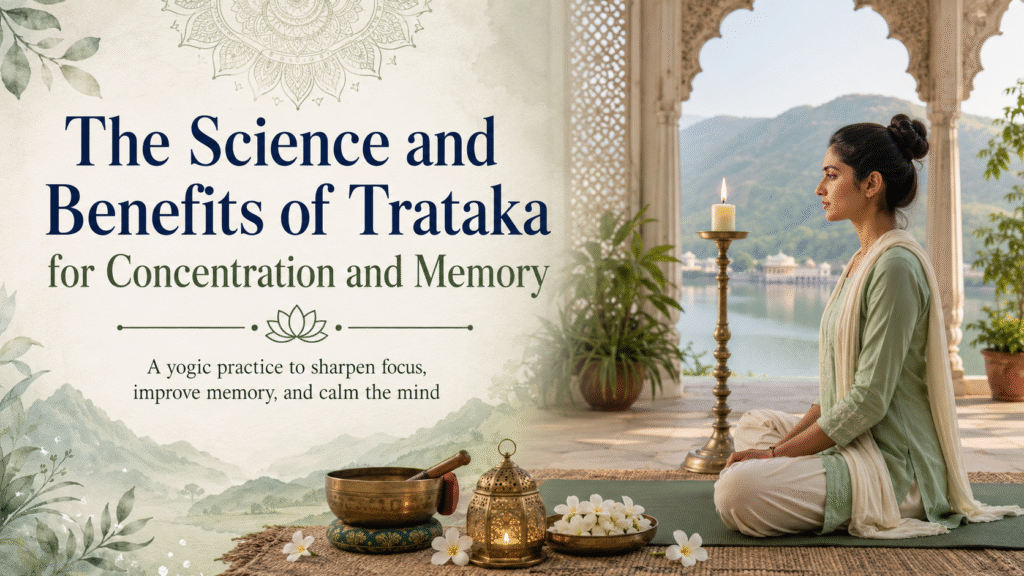
In the present age, one of the biggest problems people face is lack of concentration. Whether it is a student preparing for exams, a working professional managing multiple responsibilities, a yoga practitioner trying to deepen meditation, or an elderly person wishing to keep the mind sharp, the ability to focus has become very precious. Mobile phones, social media, continuous notifications, emotional stress, poor sleep, and overthinking have made the mind restless and scattered.
In such a situation, the ancient yogic practice of Trataka becomes extremely relevant. Trataka is a simple yet powerful yogic technique in which the practitioner fixes the gaze steadily on one point, commonly a candle flame. This practice is traditionally used for improving concentration, developing mental clarity, strengthening memory, calming the mind, and preparing the practitioner for meditation.
In Indian yogic tradition, Trataka is not just an eye exercise. It is a deep practice of attention, awareness, pranic regulation, and inner stillness. It trains the eyes, but more importantly, it trains the mind. The eyes are closely connected with the nervous system and mental activity. When the eyes are restless, the mind is also restless. When the gaze becomes steady, the mind gradually becomes steady.
This is why Trataka has been respected in Hatha Yoga, meditation traditions, and spiritual disciplines for centuries. Today, modern science is also beginning to understand how focused visual attention can affect concentration, working memory, attention span, and emotional regulation.
What is Trataka?
The Sanskrit word “Trataka” means steady gazing or fixed looking. In this practice, the practitioner gazes at a chosen object without unnecessary blinking or distraction. The most common form is Jyoti Trataka, or candle-gazing meditation, where the eyes are fixed on the flame of a candle placed at eye level.
There are many forms of Trataka. One may gaze at a black dot, a candle flame, a yantra, a symbol like Om, a deity image, the rising sun under proper guidance, or even an internal mental image. In the beginning, external Trataka is usually practiced. Later, internal Trataka may be introduced, where the practitioner observes the inner image of the flame or symbol after closing the eyes.
Traditionally, Trataka is included among yogic cleansing practices because it helps purify visual attention and remove mental dullness. It is also closely connected with Dharana, the yogic practice of concentration described in Patanjali Yoga. Dharana means holding the mind steadily on one object. Trataka is one of the most practical ways to develop this one-pointedness.
Why Concentration is So Important
Concentration is the foundation of learning, memory, creativity, meditation, decision-making, and emotional balance. Without concentration, the mind remains scattered. A scattered mind cannot learn deeply, remember clearly, or meditate properly.
For students, concentration helps in reading, understanding, retention, and exam performance. For professionals, it supports clarity, productivity, and decision-making. For spiritual seekers, concentration becomes the gateway to meditation and self-realization.
Memory also depends deeply on attention. We cannot remember properly what we have not attended to properly. Many people feel they have poor memory, but actually their attention is weak. If the mind is half-present while reading, listening, or studying, the memory also becomes weak. Trataka strengthens the power of attention, and through that, it can support better memory.
In simple words, attention is the doorway of memory. Trataka trains this doorway.
The Yogic Science Behind Trataka
According to yogic understanding, the mind and senses are deeply connected. The eyes are among the most active sense organs. Throughout the day, the eyes are moving from one object to another: phone, screen, people, traffic, books, advertisements, and endless visual impressions. This constant movement of the eyes keeps the mind active and scattered.
Trataka reverses this habit. Instead of allowing the eyes to jump from one object to another, we train them to remain steadily fixed on one point. This steadiness of the eyes produces steadiness of the mind.
In yogic language, Trataka helps reduce chanchalata, or restlessness of the mind. It develops ekagrata, or one-pointed concentration. It also supports pratyahara, the withdrawal of the senses, because after gazing externally, the practitioner closes the eyes and observes the inner image. This gradually shifts awareness from the outer world to the inner space.
Trataka is also associated with the Ajna Chakra, or third eye center, located between the eyebrows. This center is traditionally related to intuition, clarity, inner vision, discrimination, and higher awareness. When practiced properly, Trataka can help awaken inner perception and deepen meditative awareness.
However, this should not be misunderstood as fantasy or imagination. In authentic yoga, awakening of Ajna Chakra means refinement of perception, clarity of mind, discipline of thought, and deeper self-awareness.
The Modern Scientific View
From the modern scientific point of view, Trataka can be understood as a practice of sustained visual attention. When we look steadily at one point, the brain networks related to attention, visual processing, working memory, and executive control become engaged.
The practice may support concentration in several ways. First, it reduces distraction by giving the mind one clear object. Second, it trains inhibitory control, because the practitioner repeatedly resists the urge to look away or follow random thoughts. Third, it enhances visual-spatial attention, because the mind learns to hold one visual field steadily. Fourth, the later phase of internal visualization may support working memory because the practitioner holds the image mentally after closing the eyes.
Research on Trataka is still developing, but some studies have shown positive results. A 2021 study on yogic visual concentration found that Trataka had a positive impact on working memory, spatial memory, and spatial attention in young adults. Another study on elderly participants suggested that regular Trataka practice may support cognitive functions such as attention, concentration, and short-term memory when practiced over time. These findings are promising, though more large-scale research is still needed.
This is important to understand. Yoga does not need to be exaggerated to be respected. Trataka is powerful, but it is not magic. Its benefits come through regularity, correct method, proper guidance, and a balanced lifestyle.
How Trataka Helps Concentration
Trataka develops concentration through repeated training of attention. Normally, the mind jumps very quickly from one thought to another. One moment it is thinking about work, next moment about the past, then the future, then a phone message, then some worry. This constant jumping weakens mental energy.
When we sit for Trataka, we give the mind one instruction: stay with this point. At first, the mind resists. Thoughts come. The eyes water. The body wants to move. The mind says, “Enough.” But with gentle discipline, the practitioner learns to remain steady.
This is like training a muscle. Just as physical exercise strengthens the body, Trataka strengthens the attention muscle. Over time, the mind becomes less scattered and more capable of staying with one task.
For students, this can be very helpful. If practiced regularly, Trataka may support better reading focus, reduced distraction, and improved ability to sit for study. For working professionals, it can help reduce mental switching and improve clarity. For meditators, it prepares the mind for deeper meditation.
How Trataka Supports Memory
Memory has three main stages: attention, encoding, and recall. First, the mind must pay attention. Then the information must be properly registered. Later, it must be recalled. If attention is weak, the first stage itself becomes weak. This is why poor concentration often looks like poor memory.
Trataka improves the quality of attention. When attention becomes stronger, learning becomes deeper. When learning becomes deeper, memory becomes clearer.
Trataka may also support visual memory. In candle gazing, after looking at the flame, the practitioner closes the eyes and observes the inner image of the flame. This inner image may appear between the eyebrows or in the mental field. Holding this inner image requires visual memory and mental steadiness. Over time, this can strengthen the ability to retain and recall visual impressions.
This is especially useful for students, artists, meditators, healers, and anyone who needs clarity of mental imagery.
Trataka and Mental Calmness
One of the beautiful benefits of Trataka is that it not only sharpens the mind but also calms it. Many practices improve alertness but may also create tension. Trataka, when done correctly, creates alert relaxation. The mind becomes focused but not aggressive. The body becomes still but not rigid.
The candle flame has a naturally soothing effect. Gazing at a steady flame in a quiet space can reduce mental noise. The breath slows down. The eyes become steady. The nervous system begins to relax. After closing the eyes, the practitioner often feels a soft inner silence.
This is why Trataka is useful not only for memory and concentration, but also for stress, anxiety, overthinking, and mental fatigue. It helps collect the scattered mind and bring it into one peaceful stream.
Trataka and Eye Health
Traditionally, Trataka is also said to support eye health by strengthening the eye muscles and improving the steadiness of vision. The practice involves focused gazing, controlled blinking, and later relaxation of the eyes. This can help people become more aware of eye strain, especially in the modern digital lifestyle.
However, one should practice carefully. Trataka should not be done aggressively. The eyes should not be forced. If there is burning, pain, severe dryness, headache, or dizziness, the practice should be stopped. People with glaucoma, recent eye surgery, serious eye disease, severe migraine, epilepsy, or neurological conditions should consult a doctor and practice only under expert guidance.
For general practitioners, palming should be done after Trataka. Rub the palms gently until warm, cup them softly over the closed eyes without pressure, and relax. This soothes the optic nerves and gives rest to the eyes.
How to Practice Candle Trataka
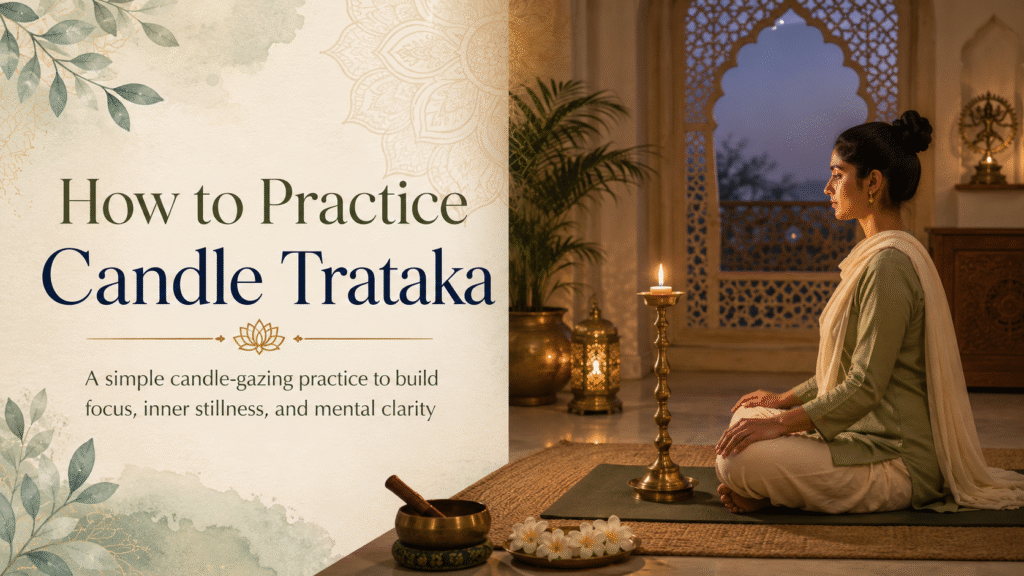
Choose a quiet, clean, and dimly lit place. Sit comfortably in Sukhasana, Vajrasana, or on a chair with the spine straight. Place a candle at eye level, about two to three feet away. The flame should be steady, so avoid strong wind or fan.
Sit quietly for a few moments and let the breath become natural. Now gaze gently at the flame, preferably at the brightest part of the flame. Keep the eyes steady, but do not strain. Try not to blink unnecessarily, but if blinking happens, do not become disturbed. Continue gazing.
In the beginning, practice only for 30 seconds to 1 minute. Then close the eyes and observe the after-image of the flame in the inner space. Watch it calmly until it fades. Then rub the palms and practice palming over the eyes.
Gradually, with regular practice, the duration may be increased to 3 to 5 minutes of gazing, followed by internal observation. Advanced practice should be done only under guidance.
The best time is early morning or evening. Avoid practicing immediately after heavy food. Also avoid practicing when the mind is highly disturbed, when the eyes are extremely tired, or when there is severe headache.
Important Safety Guidelines
Trataka should always be practiced with gentleness. The purpose is not to torture the eyes. The purpose is to develop steady awareness. Tears may come naturally, but one should not force the eyes to water. If discomfort arises, close the eyes and rest.
Do not stare at the sun unless properly guided by an expert and only at safe times, because direct sun gazing can damage the eyes. Candle Trataka is safer for most people when practiced properly.
Children should practice only for a short duration and under supervision. People with psychological conditions involving hallucinations, psychosis, or severe dissociation should avoid Trataka unless guided by a qualified healthcare and yoga professional. Since Trataka involves visual concentration and inner imagery, it may not be suitable for everyone.
Also, Trataka should not be used as a replacement for medical treatment, psychological therapy, or educational support. It can be a supportive yogic practice along with a healthy lifestyle and proper care.
Trataka for Students
Students can benefit greatly from Trataka when it is practiced regularly and sensibly. In student life, distractions are very high. Many students read for long hours but retain very little because the mind is not fully present.
A simple routine can be followed. Before study, the student may sit quietly and practice candle Trataka for 2 to 3 minutes, followed by palming and 1 minute of silent breathing. Then study can begin. This small practice can prepare the mind to enter a focused state.
However, students should not overdo it. Too much effort may create eye strain or headache. Small, regular practice is better than long, forceful practice.
Along with Trataka, students should also maintain proper sleep, healthy food, regular revision, screen breaks, and physical activity. Memory is not improved by one technique alone. It is supported by the whole lifestyle.
Trataka for Professionals
Professionals often suffer from mental overload because of continuous screen work, meetings, deadlines, and multitasking. The modern work culture constantly pulls attention in different directions. Trataka can help professionals regain mental clarity.
Practicing Trataka in the evening can help release screen fatigue and collect the mind. It may also help reduce the habit of mental jumping. Even 5 minutes of candle gazing followed by quiet sitting can create a refreshing shift.
For professionals, Trataka should be combined with digital discipline. Keep small breaks from the screen, blink consciously, relax the shoulders, and avoid excessive late-night screen exposure. Trataka works best when the overall lifestyle supports the mind and eyes.
Trataka for Meditation Practitioners
For meditation practitioners, Trataka is a very valuable preparatory practice. Many people complain that they cannot meditate because thoughts keep coming. Trataka gives the mind a visible anchor. The flame becomes a bridge from outer attention to inner stillness.
After gazing at the flame, when the eyes are closed, the mind continues to hold the subtle image. This naturally leads toward internal concentration. Slowly, the practitioner may experience more silence, steadiness, and inwardness.
In deeper practice, Trataka becomes less about the candle and more about awareness itself. The flame outside awakens the flame inside. The outer light becomes a symbol of inner consciousness.
Traditional Spiritual Benefits of Trataka
In the spiritual path, Trataka is used for purification of mind, development of willpower, awakening of inner vision, and strengthening of meditative absorption. It helps reduce distraction and prepares the practitioner for Dharana and Dhyana.
The flame is also a powerful spiritual symbol. Fire represents purification, clarity, transformation, and divine light. When we gaze at the flame, we are not merely looking at fire. We are training ourselves to become steady like the flame, bright like the flame, and pure like the flame.
In Indian tradition, light has always been a symbol of knowledge. “Tamaso ma jyotir gamaya” means, “Lead me from darkness to light.” Trataka is one practical way to move from the darkness of distraction to the light of awareness.
Learn Trataka at Adwait Yoga School
Those who wish to learn Trataka deeply and systematically can explore the Trataka Training Courses offered by Adwait Yoga School.
Adwait Yoga School offers structured Trataka Training Courses in Level 1, Level 2, and Level 3. These courses are designed to help students build concentration, mental clarity, meditation depth, and spiritual awareness step by step. The training includes external Trataka, internal Trataka, candle gazing, dot gazing, visualization techniques, pranayama for focus, and deeper meditative preparation.
You can visit the Trataka Training Course page here:
For beginners, the Level 1 course is especially useful as it lays the foundation of Trataka practice in a safe, structured, and guided manner. The course helps students understand the correct method, precautions, traditional background, and practical application of Trataka for concentration and inner clarity.
Learning from a qualified teacher is always better than practicing randomly, especially when the practice involves eyes, nervous system, concentration, and subtle meditative states.
Conclusion
Trataka is a simple but profound practice. It begins with looking at a flame, but gradually it becomes a journey into attention, memory, mental discipline, inner silence, and spiritual clarity.
In a world full of distraction, Trataka teaches us the lost art of looking steadily. When the gaze becomes steady, the breath becomes steady. When the breath becomes steady, the mind becomes steady. When the mind becomes steady, memory becomes clearer, concentration becomes stronger, and inner awareness begins to shine.
The science of Trataka shows us that focused visual attention may support working memory, spatial attention, and cognitive clarity. The yogic tradition shows us that Trataka develops ekagrata, cleanses the mind, awakens inner perception, and prepares the practitioner for meditation.
For students, it can support study and memory. For professionals, it can reduce scattered attention. For meditators, it can deepen inner practice. For spiritual seekers, it can become a doorway to stillness and self-awareness.
But like all yogic practices, Trataka should be practiced with patience, regularity, humility, and proper guidance. It is not about force. It is about steadiness. It is not about staring aggressively. It is about seeing consciously.
In the flame of Trataka, the practitioner slowly discovers that concentration is not tension. True concentration is relaxed awareness. Memory is not only mental storage. True memory improves when the mind becomes present. And meditation is not escape. It is returning to the light of one’s own consciousness.
Trataka reminds us that when we learn to hold our gaze, we also learn to hold our mind. And when the mind becomes steady, the inner light begins to reveal itself.